

A valid driving licence confirms baseline legality, but it does virtually nothing to insulate an organisation against catastrophic operational liability. For corporate fleets confronting escalating incident rates across demanding transit routes, securing professional defensive driving training South Africa operations require has become an indispensable risk-containment strategy. True fleet resilience demands far more than basic regulatory licensing; it requires proactive, measurable behavioural intervention behind the wheel.
You already recognise the acute commercial strain caused by unbudgeted vehicle downtime, accelerating depreciation, and soaring insurance excesses, whilst statutory frameworks place strict occupational duty of care obligations on enterprise leadership. This guide demonstrates how structured defensive driving programmes systematically mitigate transit risks, safeguard operational capital, and ensure thorough alignment with national safety mandates. Ahead, we examine the core mechanics of corporate driver education and outline an actionable framework to lower collision frequencies across your entire fleet footprint.
Key Takeaways
- Discover why corporate defensive driving training south africa organisations implement is essential for transforming baseline licensing into proactive, predictive hazard management.
- Master advanced visual scanning and dynamic space-cushion methodologies engineered to counteract sudden hazards and accommodate variable vehicle braking distances.
- Examine how smooth momentum management directly lowers operational expenditure by curtailing excessive fuel consumption and premature mechanical wear.
- Align fleet safety policies with national occupational health and safety governance to satisfy institutional duty of care and curb vicarious liability.
- Establish a scalable, tiered driver development framework that leverages historical telematics data across diverse commercial vehicle categories.
Understanding Defensive Driving Training within the South African Fleet Landscape
Defensive driving is fundamentally a disciplined framework of systematic hazard anticipation, deliberate spatial positioning, and proactive collision avoidance. While standard vehicular licences confirm that an operator can mechanically control a machine, they don’t instil the cognitive discipline required to neutralise volatile road conditions before an emergency manifests. For commercial operators, professional defensive driving training south africa fleets rely upon transforms daily transit from an unmanaged operational hazard into a measurable risk-containment process. Instilling these proactive behaviours protects human capital, stabilises asset lifecycle costs, and shields the enterprise from disruptive downtime.
The Distinction Between Basic Licencing and Defensive Competence
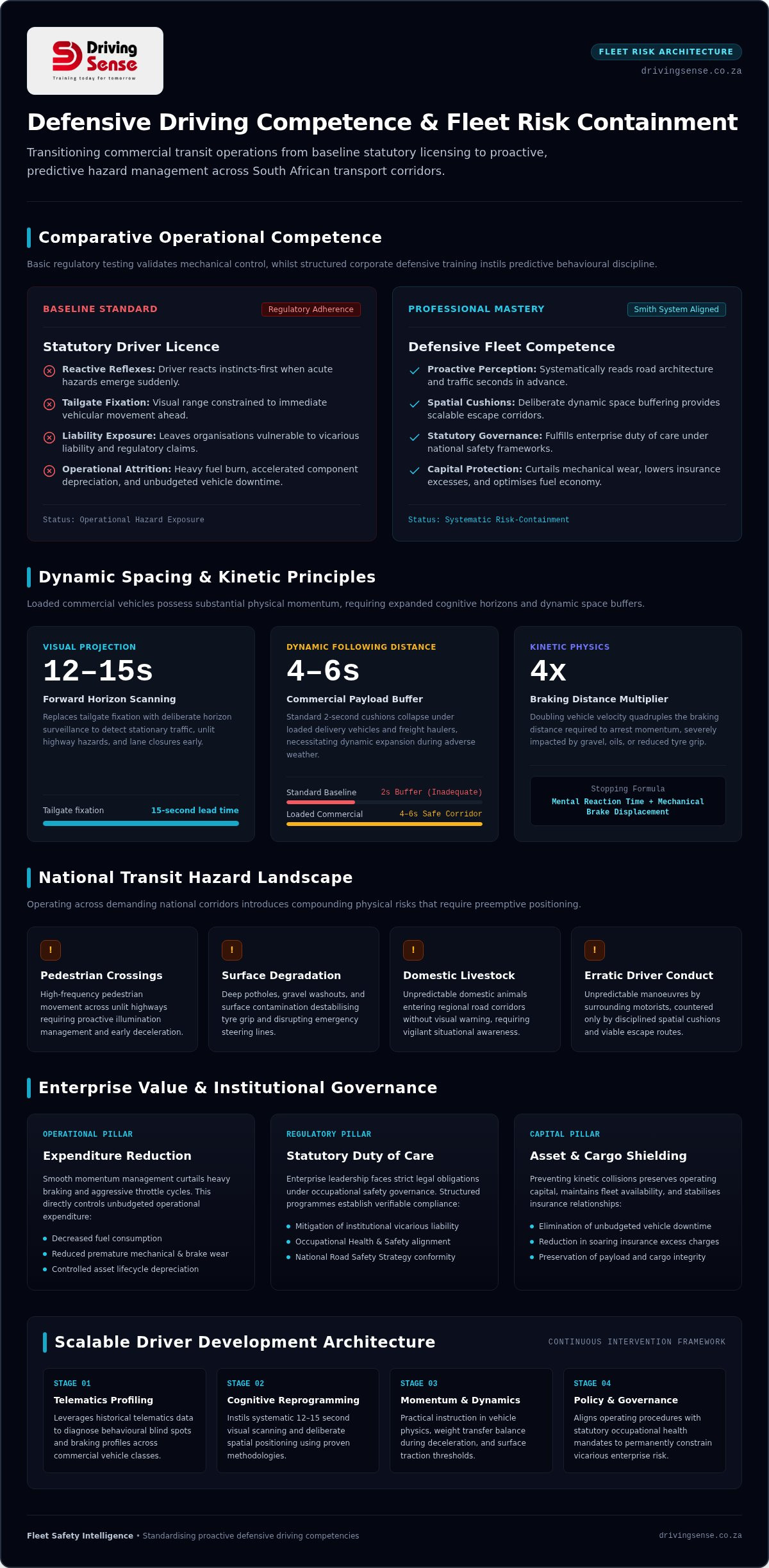
Statutory licensing merely certifies baseline procedural adherence under controlled testing criteria. Advanced corporate competence, however, demands continuous situational awareness and predictive threat perception under genuine operational stress. Commercially licensed drivers often develop behavioural blind spots when managing tight scheduling pressures, reacting instinctively to emergencies rather than anticipating them. Structured methodologies, such as the Smith System of deliberate visual positioning and dynamic space creation, bridge this critical gap. Drivers learn to read road architecture and traffic patterns seconds ahead, replacing panic-induced braking with calculated, preemptive speed adjustments.
Prevailing Environmental and Operational Hazards on National Roads
Navigating the country’s extensive transit corridors exposes commercial fleets to severe, compound hazards. Fleets regularly confront erratic driver conduct, high-frequency pedestrian crossings along unlit highways, domestic livestock, and critical surface degradation like deep potholes. Furthermore, loaded commercial vehicles carry immense physical momentum; their extended stopping distances leave zero margin for driver distraction or delayed reflexes. Without the structured defensive driving training south africa logistics environments demand, operators routinely fail to maintain protective safety buffers. This absence of spatial cushion leaves fleet assets, drivers, and cargo exposed to severe kinetic collisions.
Core Methodologies of Professional Defensive Driver Instruction
Modern fleet risk mitigation relies on deliberate, science-backed behavioural techniques. While basic instruction focuses simply on vehicle controls, professional corporate training systematically reprograms how an operator perceives risk, manages space, and processes environmental input under pressure. When enterprises implement professional driver training solutions, they align internal operating procedures directly with the objectives set out in the National Road Safety Strategy, establishing measurable defensive buffers that shield both personnel and balance sheets.
Systematic Visual Scanning and Space Cushion Management
Effective spatial management begins with dynamic horizon scanning. Drivers learn to project their visual focus twelve to fifteen seconds ahead rather than fixating on the tailgate directly in front. This extended horizon provides the critical lead time needed to detect stationary vehicles, livestock, or unexpected lane closures. Following distances must also expand dynamically. Standard two-second buffers collapse under heavy commercial payloads; loaded light delivery vehicles and heavy freight haulers require four to six seconds minimum, scaling upward during adverse weather to preserve viable escape corridors.
Vehicle Dynamics, Traction Thresholds, and Reaction Time
Total stopping distance combines mental reaction time with mechanical brake displacement. When road surfaces suffer from gravel or wet oils, available tyre grip decreases sharply. Professional instruction grounds drivers in the fundamental physics of momentum and lateral load transfer:
- Kinetic energy dissipation: Doubling vehicle velocity quadruples the braking distance required to stop safely.
- Weight transfer balance: Sudden steering adjustments during heavy deceleration destabilise the chassis, causing severe lateral slide.
- Predictive cadence braking: Smooth, threshold brake applications maintain tyre adhesion without triggering disruptive electronic stability interventions.
Managing Cognitive Fatigue, Stress, and Operational Distractions
How does cognitive load influence fleet accident rates? Prolonged hours behind the wheel degrade situational vigilance long before an operator physically nods off. High-calibre defensive driving training south africa operations mandate bridges the gap between onboard telematics metrics and human psychology. Drivers are trained to recognise early micro-fatigue indicators, enforce strict device disconnection protocols, and apply psychological de-escalation methods when encountering aggressive road users. Rather than passively reacting to erratic external events, operators maintain calculated emotional detachment, preserving safe vehicle spacing across demanding long-haul routes.
Comparative Framework: Standard Driver Competence Versus Advanced Defensive Training
Standard driving competence relies almost entirely on reactive reflexes, leaving vehicle control to the mercy of immediate sensory inputs. When an unpredicted obstacle appears, the average motorist reacts abruptly, applying full braking pressure or executing erratic steering evasions. Professional defensive driving training south africa enterprises commission establishes a predictive operational model instead. Drivers learn to manage vehicle momentum methodically, reading dynamic traffic cues hundreds of metres ahead to neutralise volatile situations before severe kinetic forces come into play.
Curriculum Divergence: Reactive Operation Versus Predictive Positioning
The operational gap between unrefined driving habits and advanced defensive behaviour reflects distinct operational philosophies. Conventional drivers accelerate aggressively into closing gaps, brake late at congested intersections, and hug large transport vehicles, severely restricting forward sightlines. In contrast, advanced defensive curricula instil continuous spatial containment and proactive momentum management:
- Momentum conservation: Early throttle release and engine compression braking replace harsh, late mechanical braking, reducing component fatigue and thermal load.
- Intersection clearing: Rather than blindly accelerating on a green signal, trained drivers pause, verify lateral clear zones, and actively scan for cross-traffic red-light runners.
- Sightline preservation: Tactical lane positioning keeps the vehicle outside the blind spots of larger commercial units, ensuring unobstructed views of developing hazards ahead.
Telematics Integration and Real-Time Driver Performance Verification
How does defensive driving translate into measurable corporate telematics outputs? Fleet management systems frequently log harsh acceleration, severe cornering, and rapid deceleration events that directly indicate reactive driving patterns. When operators undergo targeted defensive driving training south africa fleet standards require, onboard telemetry metrics reflect an immediate drop in high-risk threshold breaches.
Proactive spatial buffering eliminates the sudden panic stops that trigger elevated g-force warnings. Smooth momentum preservation stabilises engine load profiles, curbing excess fuel consumption while significantly extending the operational lifespan of tyres, brake assemblies, and transmission components. By leveraging objective telematics scoring, risk managers can verify the sustained real-world impact of driver education, transforming abstract safety guidelines into auditable, cost-saving operational performance.
Corporate Governance, Statutory Duty of Care, and Financial Risk Containment
Enterprise directors carry profound legal responsibility for road operations. Under national occupational health and safety legislation, a company vehicle functions legally as an extension of the physical workplace. Dispatching an employee into active transit without structured, documented driver safety instruction exposes corporate leadership to severe statutory liability, regulatory fines, and reputational damage. Enrolling personnel in professional defensive driving training south africa operations require establishes a documented compliance audit trail, confirming that the enterprise has taken all reasonably practicable steps to protect its workforce.
Occupational Health and Safety Alignment in Commercial Transport
Corporate duty of care does not terminate at the perimeter gate. Operational safety directors must proactively manage road risks with the same institutional rigor applied to fixed industrial environments. Maintaining defensible governance requires moving beyond ad-hoc workshops to systematic risk controls:
- Designated workplace status: Regulators view commercial vehicles as mobile work environments requiring active risk assessments and mandatory hazard controls.
- Verifiable training records: Accredited, documented driver competencies provide essential evidentiary support during statutory safety inquiries following severe incidents.
- Vicarious liability containment: Proving ongoing safety interventions shields company leadership from charges of organizational negligence if an unpreventable collision occurs.
Direct Loss Mitigation and Insurance Premium Optimisation
What are the hidden financial impacts of a serious fleet collision? Direct vehicle damage represents only the visible tip of overall enterprise losses. Beyond immediate repairs and insurance excesses, organizations face unbudgeted asset downtime, temporary rental commitments, lost cargo, missed client delivery deadlines, and disrupted operational continuity.
Underwriters adjust fleet insurance premiums based directly on historical loss ratios and verified internal risk-management mechanisms. Implementing accredited defensive driving training south africa fleet managers deploy drives down collision claim frequencies, positioning the organization for substantial premium restructuring during annual policy renewals. Moreover, moderating operational speeds and coaching smooth cruising habits yields immediate reductions in bulk fuel expenditure, delivering rapid bottom-line returns on training capital. To build a compliant, cost-resilient transport operation, explore certified corporate safety programmes tailored to your enterprise fleet profile.
Implementing a Scalable Corporate Defensive Driving Framework
Deploying an enterprise-wide driver intervention requires methodical execution rather than generic, off-the-shelf coursework. High-performing organisations structure their safety rollout by systematically auditing risk profiles, configuring modular training tracks, and embedding performance analytics into corporate governance. By tailoring defensive driving training south africa operations demand to distinct vehicle categories, fleet operators protect business continuity without compromising daily logistics schedules.
Auditing Internal Fleet Risk and Establishing Performance Baselines
A resilient framework starts with empirical baseline data. Organizations must cross-reference historical accident registers, insurance loss run reports, and ongoing telematics exceptions to identify structural vulnerabilities across operational driver pools:
- Operational tiering: Differentiate instruction based on operational exposure, separating executive passenger transport, light commercial delivery routes, and heavy articulated haulage.
- Pre-training behavioural profiling: Screen drivers beforehand to diagnose ingrained habits such as aggressive lane navigation, persistent tailgating, or late braking tendencies.
- Remedial risk prioritisation: Direct high-risk operators exhibiting frequent telemetry infractions into priority corrective streams before operational incidents occur.
Deploying Flexible, High-Impact Corporate Training Pathways
How can enterprise fleets execute comprehensive driver upskilling without disrupting vital commercial shift work? The solution lies in flexible delivery models that combine targeted theoretical compliance modules with supervised on-road coaching. In-vehicle evaluations allow instructors to correct subtle cognitive misjudgements directly within the vehicle classes operators drive daily. To address unique risk environments across light, medium, and heavy transport assets, organisations regularly review institutional safety solutions with Driving Sense corporate driver training to maintain consistent operational momentum.
Sustaining Long-Term Cultural Change and Measurable Outcomes
Behavioural adaptation decays without deliberate reinforcement. A successful safety intervention requires regular annual refresher programmes to counteract cognitive regression and overconfidence. Furthermore, enterprise safety leadership must integrate driver performance scoring into executive occupational health and safety dashboards. When drivers realise that spatial discipline, smooth vehicle control, and route compliance are actively reviewed by management, defensive protocols become central to the organizational identity. Fleet leaders can explore end-to-end risk mitigation through Driving Sense professional safety programmes, securing long-term compliance, reducing loss ratios, and preserving vital operational capital.
Transforming Fleet Safety into Sustainable Corporate Value
Mitigating transit risk across enterprise operations requires an institutional commitment that extends far beyond baseline licensing. By transitioning from reactive vehicle handling to structured hazard anticipation, corporate fleets systematically curb collision frequencies, reduce unbudgeted asset downtime, and lower operating overheads. Embedding comprehensive defensive driving training south africa enterprises depend upon ensures continuous alignment with statutory occupational health mandates whilst preserving critical balance-sheet capital.
With two decades of dedicated occupational safety experience since 2006, Driving Sense delivers tailored instruction that bridges practical vehicle dynamics and statutory governance. Their field-proven methodologies help logistics operators and commercial fleets suppress loss ratios, eliminate preventable mechanical strain, and instil a resilient culture of road discipline. Partner with Driving Sense to implement corporate defensive driver training and secure an enduring standard of road safety excellence across your operational footprint.
Frequently Asked Questions
How does defensive driving training differ from standard corporate driver instruction?
Defensive driving prioritises predictive hazard recognition and spatial control, whereas standard driver instruction focuses primarily on mechanical vehicle operation and basic road-rule adherence. Professional defensive driving training south africa organisations commission trains drivers to continuously evaluate evolving road hazards, manage gross vehicle momentum, and actively create escape paths. This systematic, cognitive approach shifts operators from reactive, high-stress reflexes to disciplined, early intervention before emergency braking becomes necessary.
Is defensive driving training mandatory under national occupational safety legislation?
While legislation doesn’t explicitly name defensive courses, it places strict statutory duty of care obligations on employers to maintain a safe working environment. Because company vehicles are legally recognised as workplaces during commercial transit, assigning staff without documented risk-mitigation training exposes directors to statutory liability. Implementing verified defensive instruction establishes a defensible compliance trail, proving an organisation has taken all reasonably practicable steps to safeguard its travelling workforce.
How frequently should commercial fleet operators undergo defensive driving refresher courses?
Enterprises should schedule structured refresher programmes annually to counteract behavioural drift, situational complacency, and driver overconfidence. Operators handling high-risk delivery schedules or heavy commercial vehicles often benefit from biannual modular interventions. Continuous evaluation ensures learned spatial habits remain sharp. Immediate remedial sessions are also advisable whenever internal telematics systems detect a spike in harsh deceleration events or after an operator experiences an avoidable minor incident.
Can advanced driver training measurably lower enterprise fleet operating expenses?
Yes, structured defensive driving training south africa programmes directly compress core fleet operating costs. Teaching drivers proactive momentum conservation and progressive deceleration curbs rapid brake disc wear, preserves tyre tread, and reduces excessive fuel consumption. Additionally, suppressing collision frequencies improves loss ratios with corporate underwriters, paving the way for lower insurance excesses and negotiated premium reductions whilst preventing the heavy indirect costs of unplanned vehicle downtime.
What specific topics are addressed during corporate defensive driving instruction?
Core curricula encompass dynamic hazard scanning, kinetic energy dissipation, space cushion expansion, and adverse weather adaptation. Instructors also address cognitive fatigue management, distraction mitigation protocols, and psychological de-escalation for aggressive traffic interactions. Rather than generic classroom theory, practical sessions evaluate vehicle weight distribution during emergency avoidance manoeuvres, ensuring drivers understand how physical cargo loads alter operational stopping distances across degraded road infrastructure.
How does defensive driving instruction integrate with existing vehicle telematics systems?
Defensive instruction translates telematics exceptions into targeted behavioural corrections. Telemetry hardware flags harsh acceleration, erratic cornering, and rapid braking, but it doesn’t coach the underlying behaviour. By correlating telematics data with defensive principles, trainers can identify root causes, such as inadequate visual horizons or following too closely. Drivers learn how spatial positioning directly prevents the sudden manoeuvres that trigger telematics warnings.
What qualifications should enterprises look for when selecting a driver training provider?
Organisations should partner with established providers possessing verified corporate safety credentials and multi-vehicle instructional capabilities. Look for established providers, such as Driving Sense, bringing two decades of dedicated occupational safety experience and national delivery reach. The provider must align practical in-vehicle coaching with national regulatory frameworks, offer bespoke fleet risk assessments, and maintain accredited training records that withstand rigorous corporate governance audits.
