

A HAZCHEM course may cover important safety principles without meeting the needs of a learner’s actual role. For employers considering HAZCHEM training south africa, the distinction matters: training should connect hazard awareness to workplace responsibilities, rather than simply provide a certificate.
It’s understandable to want clarity about what learners will study and whether HAZCHEM training is the same as dangerous goods driver certification. A course may cover hazard classification, labelling, safe handling, transport documentation or emergency response. Drivers transporting dangerous goods may also need to meet separate requirements. The details depend on the work being performed and current requirements.
This article explains the practical purpose and scope of HAZCHEM training, how it differs from driver-related requirements, and what employers should check about course content, credentials and learner suitability. Driving Sense provides statutory and legislative training, with a focus on both compliance and competence. Its alignment with the QCTO framework should not be taken as confirmation that the company itself is QCTO-accredited or that a specific HAZCHEM course is available. Reviewing learners’ duties and requirements before making an enquiry can help identify appropriate training.
Key Takeaways
- Assess HAZCHEM training south africa against learners’ actual tasks, workplace hazards and employer procedures, not just the course title.
- Compare the course outline with the hazards, communication systems and safe procedures relevant to the substances and work involved.
- Check whether learners need separate dangerous goods training or driver credentials, and verify current requirements for their roles.
- Before enrolment, review provider credentials, prerequisites, learner support and practical arrangements. Confirm details directly rather than assuming they are included.
- Discuss learner readiness and training requirements with the provider so the selected course supports compliance and workplace competence.
What is HAZCHEM Training in South Africa and its Purpose?
HAZCHEM training is intended to help people recognise hazardous chemical risks, understand how those risks are communicated and follow procedures relevant to their work. The term does not, by itself, identify one universal qualification or guarantee that a course meets every workplace or transport requirement. When assessing HAZCHEM training South Africa, employers should review the course outline and confirm that its scope suits learners’ duties and applicable requirements.
The purpose is practical: learners need to interpret hazard information and know how to respond within their role, rather than rely on the course title alone. Clear hazard communication, safe work procedures and role-relevant knowledge can help organisations manage risk consistently. Confirm the course’s learning outcomes, assessment and any recognition with the provider.
What does HAZCHEM mean in a workplace context?
In everyday workplace use, “HAZCHEM” may refer broadly to awareness and training related to hazardous chemicals. It can also refer to a warning plate system used to communicate information about dangerous goods. The Hazchem warning plate system includes elements such as an Emergency Action Code and a UN number. Understanding these cues is different from assuming that every HAZCHEM-labelled course teaches the same material.
For safe handling, learners may need to connect chemical hazards and label information with procedures relevant to their site, substance and task. Course content varies, so ask the provider which topics it covers and how they relate to workplace practice.
Who may need HAZCHEM-related training?
Potential learners include workers who handle, store or move hazardous substances, as well as supervisors who coordinate work where these risks may arise. In a logistics setting, for example, relevant roles could include staff involved in loading goods or checking shipment information. These examples do not mean that every person in such a role must complete one particular course.
Start with the work itself. Identify the substances and tasks involved, consider who needs to recognise or communicate hazards, and match training to those responsibilities. General awareness may suit some learners, while others may need training for more specific duties or separate credentials. Confirm current requirements and course suitability before enrolment. Driving Sense provides statutory and legislative training that balances compliance and competence. Check directly whether a particular HAZCHEM course is available.
What HAZCHEM Training Covers: From Hazard Recognition to Safe Procedures
Useful HAZCHEM training should help learners move from recognising a potential hazard to understanding what information and workplace procedures guide their next steps. Learning outcomes depend on the course, the substances and tasks involved, and the employer’s established controls. A course title alone is not enough to confirm suitability.
Practical competence matters alongside regulatory awareness. Learners need to interpret relevant information and apply it appropriately within their assigned duties. Training supports this capability, but it does not replace workplace procedures, supervision or the need to check current requirements.
Recognising hazard information and communication
Labels, Safety Data Sheets (SDS) and hazard placards communicate information in different ways. A label can identify a product and communicate hazard information; an SDS provides more detailed information about a substance; and a placard may communicate transport-related hazard information. Materials and terminology can vary across settings, so check that the course content reflects the substances and information systems learners are likely to encounter.
Learners should know how to consult relevant workplace guidance and whom to approach if information is missing, unclear or inconsistent. For transport and packaging context, the Chemical and Allied Industries’ Association provides information on relevant standards. Employers should still verify which requirements and procedures apply to their operations.
Turning training into safe workplace behaviour
Knowledge has operational value when it connects with established procedures, appropriate supervision and clear reporting routes. Learners should know where to find guidance relevant to their tasks, how to raise a concern and which responsible person to consult. General awareness should not be treated as a basis for decisions outside their role.
Scenario-based discussion can help learners consider how hazard information relates to a work situation, if the provider confirms that this method is part of the course. Ask how learning is assessed and whether examples reflect the organisation’s operational context. No training course on its own can guarantee that incidents will be prevented or that an organisation will meet every applicable requirement.
Before selecting HAZCHEM training South Africa, compare the course outline with learners’ duties and workplace procedures, then ask the provider about any gaps. Organisations considering statutory or legislative training can discuss learner roles and training requirements with Driving Sense before deciding what may be suitable.
HAZCHEM Training, Dangerous Goods Training and Driver Certification: What Is Different?
Course descriptions may mention HAZCHEM, dangerous goods and driver certification together, but the terms are not interchangeable. When assessing HAZCHEM training South Africa, identify what each course or credential is intended to demonstrate, who it is designed for and whether it fits the learner’s duties. A course title alone does not confirm recognition or suitability.
| Category | Purpose and intended learner | Typical context and questions to verify |
|---|---|---|
| HAZCHEM awareness | May introduce recognition of chemical hazards and how hazard information relates to workplace procedures. It may suit workers or supervisors who encounter relevant risks. | Ask which hazards and procedures are covered, who the course is designed for, and whether it addresses the learner’s work setting. |
| Dangerous goods training | May address knowledge relevant to handling or transporting dangerous goods. The intended learner and scope depend on the specific course. | Check the course outline, assessment, intended roles and any certificate or other credential awarded. |
| Driver credentials | Credentials relate to a driver’s eligibility or qualification for particular work, rather than simply providing general hazard awareness. | Confirm which requirements apply to the driver’s role, what evidence is needed and which authority or provider can verify this. |
Is HAZCHEM training the same as dangerous goods training?
The terms may overlap in provider descriptions, but they should not be assumed to describe the same learning or outcome. Compare the objectives, detailed course outline, intended learner roles and any credential awarded. Then check whether these align with the work learners actually perform. For broader employer selection considerations, see this dangerous goods training buyer guide.
Does HAZCHEM training replace a driver certificate?
Not necessarily. Training and driver credentials can serve different purposes, so completing one course should not be taken as proof that separate requirements have been met. Employers should verify current requirements for each role with the relevant provider or authority before enrolment. For questions about what a certificate may represent, consult this dangerous goods certificate guidance.
Record the distinction in your training review: what knowledge the learner needs, what work they will undertake and what evidence the role requires. This helps prevent a general awareness course from being mistaken for a role-specific qualification, or a credential from being treated as a substitute for workplace instruction.
How South African Employers Can Check Whether HAZCHEM Training Fits
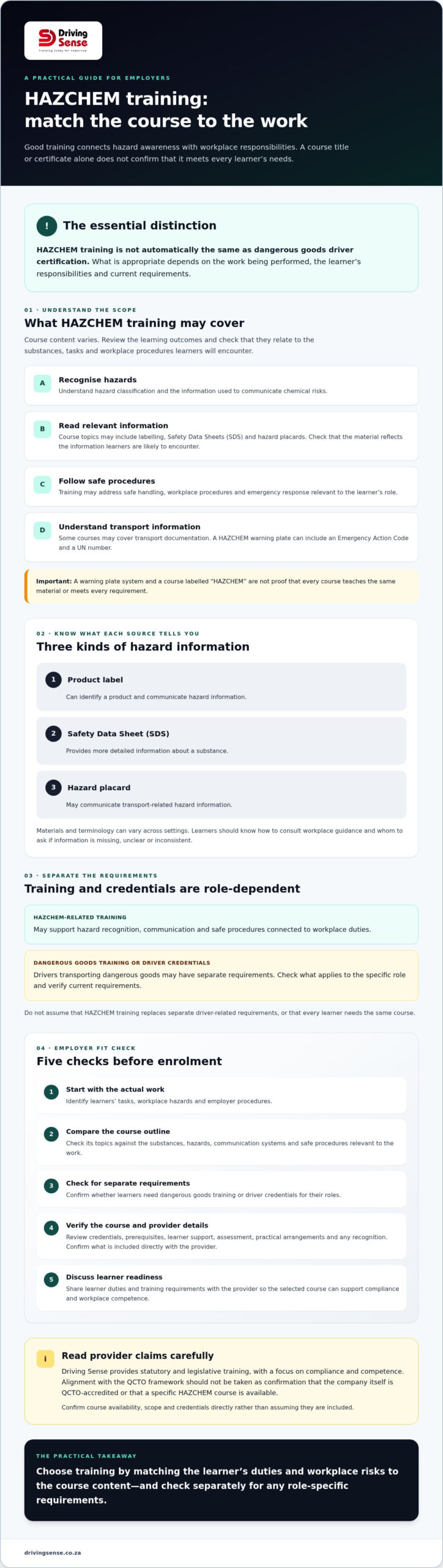
A structured review helps employers select training based on operational need, rather than relying on a course title. Before confirming enrolment, work through four checks:
- Define the roles: Record what each learner does, including handling, storing, moving or supervising work involving relevant substances.
- Identify workplace risks: Consider the goods, tasks and work settings learners may encounter, alongside the procedures they are expected to follow.
- Compare course outlines: Match the stated learning objectives and topics to those roles and risks, then ask the provider to clarify any gaps.
- Verify credentials and prerequisites: Request current information about recognition, assessment outcomes and any separate role-specific training or credentials that may apply.
Course relevance depends on alignment with learner duties. Accreditation or recognition is a separate claim that must be checked against current authoritative information.
Match the course to tasks, learners and workplace risks
Before reviewing providers, list the tasks learners perform and the hazards they may encounter. Then consider what they need to understand or demonstrate at work. Learner readiness also matters: literacy, language and prior learning can affect how well course material is understood. Ask about prerequisites and how the provider checks readiness before confirming enrolment.
Where appropriate, pre-training educational assessments can help identify readiness needs. Driving Sense offers these assessments. Employers should confirm the process and its suitability for their intended learners directly.
Verify course scope, recognition and assessment
Request current course information in writing, including learning objectives, assessment methods and details of any qualification or certificate awarded. Check what the credential represents, who recognises it and whether that recognition relates to the learner’s intended work. A reference to QCTO does not establish that a provider itself is QCTO-accredited. Verify any such claim and its relevance independently.
Ask whether learners may need additional training or credentials for particular duties, and confirm current requirements with the relevant provider or authority. This is especially important when a learner’s work involves transport responsibilities, as general awareness and role-specific requirements may differ.
When assessing HAZCHEM training South Africa, make your enquiry specific: describe the learner roles, relevant workplace risks and the outcome sought. Discuss your learner roles and training requirements with Driving Sense before deciding which statutory or legislative training may be suitable.
Choosing a HAZCHEM Training Provider and Planning the Next Step
Choosing suitable HAZCHEM training in South Africa involves more than comparing course names. Look for a provider that explains the course scope, shows how the content relates to learners’ work, supports learner readiness and makes recognition or accreditation claims clear enough to verify. Confirm the delivery format, location and availability directly rather than assuming these arrangements.
Questions to ask before selecting a provider
Request current course information before making an enrolment decision. In particular, ask for:
- The course outline and intended audience: Which learning objectives and topics are covered, and which learner roles is the course designed for?
- Assessment details: How is learning assessed, if assessment is included, and what does it establish about a learner’s knowledge or competence?
- Completion documents: What document is issued, what does it confirm, and does it represent a particular qualification or recognition?
- Delivery and support arrangements: Which format and location are available, and what learner support or prerequisites should the organisation plan for?
Ask providers to explain credentials precisely, then check claims against relevant, current information. Do not treat a course certificate or QCTO reference as proof of provider accreditation. A clear response should help distinguish course completion from formal recognition and show whether further role-specific training or credentials need to be considered.
How Driving Sense approaches statutory and legislative training
Driving Sense provides statutory and legislative training with an approach that balances compliance and competence. Its training capability extends across South Africa, and it offers pre-training educational assessments to help verify learner readiness. These details may inform an enquiry, but they do not confirm that a specifically named HAZCHEM course is available or establish any particular accreditation.
Before contacting a provider, prepare a short summary of learner roles, work-related training needs and the outcome your organisation is seeking. This gives both parties a practical basis for checking whether available training is relevant, what prerequisites may apply and which delivery arrangements need confirmation. If you’re considering HAZCHEM training South Africa, discuss your training requirements with Driving Sense before deciding on a suitable next step.
Make Your Training Decision with Confidence
Effective HAZCHEM training South Africa starts with learners’ actual responsibilities, the hazards they may encounter and the procedures they need to follow. Employers should compare those needs with the course outline, then verify assessment details, credentials and any separate requirements for specific roles. A course title alone cannot establish that training is suitable or recognised for a particular purpose.
Driving Sense, founded in 2006, provides statutory and legislative training across South Africa. Its approach balances compliance with learner competence and preparedness, supporting organisations as they consider relevant training needs. Confirm the availability and scope of any specific HAZCHEM course directly.
For a considered next step, discuss your organisation’s statutory and legislative training requirements with Driving Sense. A clear understanding of learner roles and workplace needs can help you make an informed decision and strengthen a consistent approach to safety.
Frequently Asked Questions
What is HAZCHEM training in South Africa?
HAZCHEM training in South Africa generally refers to learning that helps people recognise hazardous chemical risks, interpret relevant hazard information and understand procedures for their work. It is not one universal qualification, and course scope, assessment and completion documents can differ between providers. Before enrolling, request the current outline and compare its topics and intended learners with the work involved. People searching for HAZCHEM training south africa should also verify any role-specific requirements.
Who needs HAZCHEM training?
It may be relevant to workers who handle, store or move hazardous substances, and to supervisors who oversee work involving chemical risks. For example, logistics staff may encounter hazard information while coordinating the movement of goods, while workers at a site may need awareness suited to the substances used there. These examples are not universal rules. Employers should assess actual workplace duties and risks, then verify which course or other requirements apply to each learner.
Does HAZCHEM training include a driver certificate?
Not automatically. A course may provide learning about hazards, but a driver credential serves a separate purpose and its requirements depend on the learner’s role and applicable rules. Ask the provider what document is issued and exactly what it confirms. Do not assume a HAZCHEM course certificate qualifies someone to drive dangerous goods. Before enrolment, verify current driver requirements with an appropriate provider or authority, particularly if the learner’s duties include transport.
How can an employer check whether a HAZCHEM course is suitable?
Start by documenting learner roles, tasks and workplace risks, then request the provider’s current course objectives and outline. Check that the content matches what learners need to understand, and ask how learning is assessed and what the assessment demonstrates. Obtain details of any certificate or qualification in writing, including what it does and does not establish. Finally, verify recognition claims and confirm whether further training or credentials may apply to particular duties.
Is HAZCHEM training accredited by QCTO?
That depends on the specific course and qualification, so the term HAZCHEM alone does not establish QCTO accreditation. QCTO is now the sole accrediting body for occupational and trades-related qualifications in South Africa, but not every awareness course is necessarily an occupational qualification. Ask the provider to identify the exact qualification, relevant accreditation or recognition, and evidence supporting any claim. Verify the details independently; a reference to QCTO does not prove that a provider itself is accredited.
How often should HAZCHEM training be renewed?
There is no single renewal interval that can safely be applied to every HAZCHEM-related course or workplace. The appropriate frequency may depend on the learner’s role, the course or credential, current requirements and changes to workplace tasks or procedures. Employers should check applicable rules, maintain their own training records and ask the provider what refresher guidance applies. Confirm requirements with a relevant authority where needed rather than relying on a general course description.

Pingback: Dangerous Goods Certificate in South Africa: What Drivers and Employers Need to Know – Driving Sense
Pingback: Dangerous Goods Training South Africa: A Corporate Buying Guide – Driving Sense