

What if every employee has a training certificate, yet workers still aren’t sure what to do when a hazard arises? For South African businesses, OHS act compliance training should turn workplace responsibilities into practical competence, not simply add attendance records to a file.
It’s reasonable to want clear evidence that employees have received relevant instruction. However, course attendance alone doesn’t show that workplace risks are controlled or that safety procedures are being followed. Training supports an organisation’s wider health and safety system by helping people understand their responsibilities and apply appropriate practices in their roles.
This guide explains the purpose and scope of OHS Act compliance training, how to identify who needs training and which topics fit their work, and why learning needs to connect with risk assessments, safe work procedures and other safety controls. It also sets out practical steps for building role-relevant competence. Driving Sense provides statutory and legislative training, with pre-training educational assessments to help inform learner support where needed.
Key Takeaways
- Understand how OHS act compliance training can translate statutory awareness into practical actions suited to different workplace roles.
- Map learning needs to employees’ actual duties and workplace hazards so instruction is relevant to the risks they encounter.
- Distinguish training records from evidence that safety procedures and workplace controls are operating effectively.
- Use a structured process to identify roles, assess learning needs, select suitable instruction and plan follow-up.
- See how Driving Sense’s statutory and legislative training balances compliance knowledge with practical skill development.
What is OHS Act training and what does it achieve?
OHS Act training helps people understand relevant occupational health and safety responsibilities and apply workplace procedures. It can develop legal awareness and practical competence, but it is not a complete compliance programme on its own. Organisations also need arrangements for identifying hazards, managing risks and putting safety controls into practice.
Effective OHS act compliance training connects what a person needs to know with what they need to do. A worker who understands how to follow a procedure and report a hazard can contribute to prevention. Managers and supervisors can use their understanding to support safe work practices. Training can help people manage exposure to risk, but it cannot eliminate every hazard or replace appropriate controls and oversight.
What does the OHS Act cover at a high level?
The Occupational Health and Safety Act 85 of 1993 is the South African framework for workplace health and safety. It provides a foundation for understanding how responsibilities and safety requirements relate to work. Applicable duties and regulations depend on people’s roles and the activities taking place. A general introduction to the Occupational Health and Safety Act, 1993 can provide background, but Wikipedia is not a substitute for checking current legal requirements. Consult the current Act, applicable regulations and official sources to determine what applies to your circumstances.
A general course cannot settle every organisation’s legal position. The work being done, the hazards present and the responsibilities assigned all affect which guidance is relevant. If a requirement is unclear, verify it against current official sources instead of relying on a summary or an older training record.
Who may benefit from OHS Act compliance training?
Employers, managers, supervisors, health and safety representatives and employees may all benefit from training, but their learning needs differ. Employers and managers may need to understand how safety responsibilities are organised and supported. Supervisors may need to apply procedures in daily work, while representatives may need knowledge relevant to their workplace role. Employees need instruction that helps them carry out tasks safely and raise concerns.
Consider a workplace with an office, a storeroom and a maintenance area. Office staff, employees handling stock and workers using tools have different tasks and potential hazards. Identical instruction may not prepare everyone equally well. Match learning to each person’s duties, authority and exposure so they can recognise relevant hazards, follow applicable procedures and contribute to consistent safety practices.
How does OHS Act compliance training build practical workplace competence?
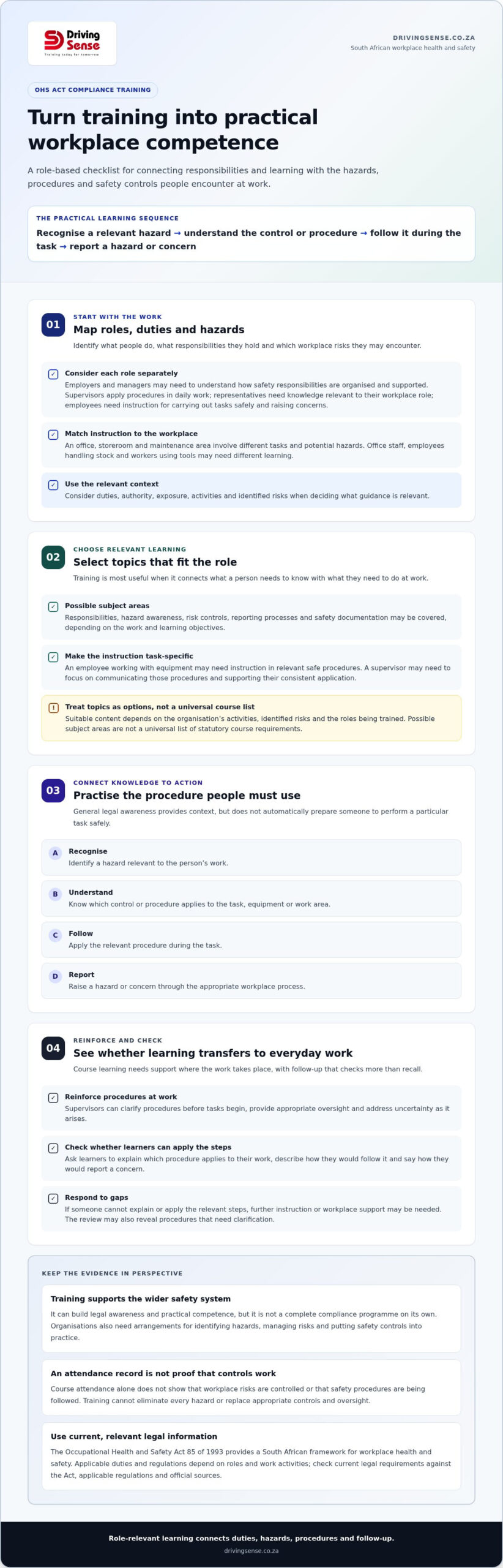
Training builds competence when it connects a person’s understanding of a responsibility with the actions they need to take at work. A practical learning sequence is to recognise a relevant hazard, understand the control or procedure, follow it during the task, and report a hazard or concern through the appropriate workplace process.
General legal awareness provides useful context, but it doesn’t automatically prepare someone to perform a particular task safely. A worker may understand why a control matters, for example, but still need specific instruction on how it applies to their equipment, work area or assigned procedure. OHS act compliance training is most useful when it reflects learners’ actual duties and workplace exposure, rather than using identical content for every role.
Role-relevant training links learning to a person’s duties, the hazards they may encounter and the controls they’re expected to use.
Which topics can OHS Act compliance training address?
Depending on the work and learning objectives, instruction may cover responsibilities, hazard awareness, risk controls, reporting processes and safety documentation. These are possible subject areas, not a universal list of statutory course requirements. Suitable content depends on the organisation’s activities, identified risks and the roles being trained.
For instance, an employee who works with equipment may need task-specific instruction in the relevant safe procedures, while a supervisor may need to focus on communicating those procedures and supporting their consistent application. In both cases, the topic should relate to the work and the controls in place. This helps distinguish a broad introduction to safety responsibilities from practical instruction for particular duties.
How should learning transfer into everyday work?
Course learning needs reinforcement where the work takes place. Supervisors can clarify procedures before tasks begin, provide appropriate oversight and address uncertainty as it arises. Workers need to know how to raise concerns and report hazards or incidents through the organisation’s established channels.
Follow-up should test more than recall. Ask learners to explain which procedure applies to their work, describe how they would follow it and say how they would report a concern. If someone can’t explain or apply the relevant steps, further instruction or workplace support may be needed. The review may also reveal procedures that need clarification.
Driving Sense’s health and safety training balances regulatory understanding with practical skill development. Organisations considering health and safety training can use role-specific learning needs to guide instruction and follow-up that support safe work practices.
Does completing OHS Act training automatically make a business compliant?
No. Training supports compliance, but completing a course does not, by itself, make a business compliant with its workplace health and safety responsibilities. OHS act compliance training can help people understand relevant duties and procedures. The organisation must also put suitable systems in place, apply them to its work and take management action when issues arise.
A certificate or attendance register records participation in training. It doesn’t show, on its own, that hazards have been identified and controlled, procedures are followed in practice or the organisation’s arrangements suit its activities. These are different forms of evidence: one records that learning took place, while the other concerns how workplace safety compliance is managed day to day.
What training can support, and what it cannot prove
Relevant instruction may improve hazard awareness, clarify responsibilities and familiarise learners with procedures that apply to their work. These are valuable outcomes, but they don’t guarantee safe behaviour, fewer incidents or legal compliance. A learner may attend and understand a procedure while necessary equipment, supervision or operational controls remain absent or inconsistently applied.
For a fuller view, consider training alongside practical indicators:
- Learning record: who attended, what instruction was covered and any relevant assessment or follow-up.
- Workplace practice: whether relevant procedures and controls are available, understood and being used.
- Management response: whether hazards, reported concerns and gaps in understanding are reviewed and addressed.
Keep records accurate about the training delivered and any follow-up that took place. A certificate should not be treated as proof that every control or responsibility is in place.
Why training must connect with workplace systems
Learning has a stronger operational context when it aligns with the organisation’s risk assessments, safe work procedures, supervision arrangements and reporting processes. These elements work together. Assessments help identify relevant risks, procedures explain how work should be done, supervisors reinforce expectations, and reporting routes help concerns reach the people responsible for responding.
After training, managers can check whether employees can explain the relevant procedure and apply it to their work. If a gap appears, the response may involve clarification, further instruction or a review of the procedure or controls. This makes a training record one part of a broader review, rather than treating course completion as the final compliance step.
For guidance on assessing course relevance as part of this wider process, see the South Africa OHS training corporate buying guide.
How can an organisation put OHS Act training into practice?
A structured process connects training decisions with workplace needs instead of treating course attendance as a stand-alone activity. For OHS act compliance training, organisations can follow these steps:
- 1. Identify roles. Map the people whose responsibilities, tasks or workplace exposure affect health and safety, including employees, supervisors and relevant representatives.
- 2. Assess learning needs. Review job responsibilities, workplace hazards and existing procedures. Decide who needs general awareness and who needs instruction linked to particular duties or tasks.
- 3. Select relevant instruction. Choose learning that reflects those roles and risks, so employees can connect the content with the procedures and controls they encounter at work.
- 4. Plan follow-up. Decide how supervisors will reinforce learning, how understanding will be reviewed and how training records will be maintained.
Identify needs, match instruction to roles and hazards, then reinforce and evaluate learning in the workplace.
How should training needs be identified?
Start with the work itself. Compare each role’s responsibilities with the hazards employees may encounter and the procedures intended to manage them. This helps distinguish a broad introduction to safety from role-specific or task-related instruction. It also grounds learning priorities in workplace conditions rather than assumptions about what everyone needs.
Learner readiness matters too. A pre-training educational assessment can help identify whether a learner may benefit from additional support to engage with the material. It informs preparation, but doesn’t replace workplace hazard assessment or the organisation’s decisions about suitable instruction.
What should happen after training?
Reinforce learning through accessible procedures, clear workplace communication and appropriate supervisory oversight. Managers can review understanding by asking questions about the relevant procedure or, where suitable, using a practical check related to the work. If a learner is uncertain, clarify the instruction and consider whether further support is appropriate.
Maintain accurate records of training and relevant follow-up. Review them alongside changes to roles, procedures or workplace hazards, and consider refresher or additional instruction when circumstances indicate a need. This creates a continuing cycle of assessment, learning and review, rather than allowing a certificate to stand in for ongoing attention to competence.
Explore Driving Sense health and safety training for support with role-relevant learning.
How does Driving Sense support OHS Act compliance training?
Driving Sense provides health and safety training and statutory and legislative training for South African organisations. Its approach balances understanding compliance requirements with developing relevant skills for safe work practices. When considering OHS act compliance training, look beyond course attendance to the knowledge and competence learners need in their roles.
What does a competence-focused training approach look like?
Training can connect legal understanding with workplace procedures and practical skills relevant to the work being performed. The appropriate learning focus depends on the organisation’s activities, identified hazards and the responsibilities assigned to learners. This keeps instruction grounded in how people are expected to work, rather than treating legislation as information to memorise in isolation.
Driving Sense uses pre-training educational assessments to help assess learner readiness and identify where support may be useful before instruction begins. This can inform how learners are prepared to engage with the material. It doesn’t replace the organisation’s responsibility to identify workplace hazards, maintain suitable procedures or reinforce learning after training. Driving Sense also advocates comprehensive medical health assessments where relevant, particularly for lifting-equipment operators, as part of considering preparedness for work-related training.
Driving Sense delivers training nationwide across South Africa. The learning is most useful when considered alongside the organisation’s work activities and the measures it uses to manage workplace risks.
Where can readers explore related training guidance?
Use the principles in this guide to consider which roles need training, what learners should understand or be able to do, and how learning will be reinforced at work. These considerations make training decisions more relevant to operational responsibilities, while keeping attendance records in perspective as one element of a wider safety system.
To explore Driving Sense’s training information and consider learning options for your organisation, visit the Driving Sense training website.
Turn OHS training into a practical workplace plan
Effective OHS act compliance training helps people understand responsibilities and apply relevant procedures, but attendance alone doesn’t demonstrate that workplace controls are working. Match learning to employees’ roles and exposure, then reinforce it through clear procedures, supervision and appropriate follow-up.
Keep training within the wider safety system: review workplace hazards, identify who needs which instruction, and assess whether learners can explain and apply what they’ve learnt. This makes training a purposeful part of managing workplace responsibilities, rather than an isolated record of course completion.
Founded in 2006, Driving Sense delivers training nationwide across South Africa, balancing compliance understanding with genuine skill development. To explore training that can support your organisation’s learning needs, explore Driving Sense health and safety training.
With relevant instruction and consistent workplace follow-through, your organisation can build competence as part of a considered approach to health and safety.
Frequently Asked Questions
What is OHS Act compliance training?
OHS Act compliance training helps people understand relevant occupational health and safety responsibilities and apply suitable workplace procedures. In South Africa, it relates to the Occupational Health and Safety Act 85 of 1993 and applicable requirements, which depend on roles and work activities. Training can build legal awareness and practical competence, but it is one element of workplace safety management, not a complete compliance programme or a substitute for current legal guidance.
Who needs OHS Act compliance training in South Africa?
Training may benefit employers, managers, supervisors, health and safety representatives and employees. Shape the content to each person’s authority, duties and workplace exposure. For example, a supervisor may need to reinforce procedures, while an employee needs to understand the instructions and reporting processes relevant to their work. Map learning to actual roles and hazards, then check current official requirements to establish which duties and training apply.
Does an OHS Act training certificate prove that a business is compliant?
No. A certificate or attendance record can show that a person took part in training, but it cannot establish by itself that hazards are controlled, procedures are followed or workplace systems are functioning. Consider training records alongside risk assessments, procedures, supervision and evidence of follow-up. Training supports understanding and competence; it doesn’t guarantee legal compliance or prove that every relevant responsibility has been met.
What topics are covered in OHS Act compliance training?
Content can include health and safety responsibilities, hazard awareness, risk controls, workplace reporting and safety documentation. Relevant topics depend on the work, hazards and roles being addressed, so a general awareness course may differ from task-related instruction. These examples are not a universal list of statutory course requirements. Align course content with the organisation’s activities and verify applicable requirements against current legislation and official guidance.
How often should OHS Act compliance training be refreshed?
There isn’t one refresh interval that applies to every role, course or workplace. Review applicable legal, regulatory and course-specific requirements, then consider whether changed duties, procedures, equipment or hazards call for further instruction. Employers can also assess whether workers still understand and apply relevant procedures. Keep accurate records of training and follow-up, and verify current requirements through official sources rather than relying on a generic timetable.
Is OHS Act compliance training the same as a full workplace safety programme?
No. Training develops knowledge and skills, while a workplace safety programme brings together the arrangements used to manage health and safety. These may include risk assessments, safe work procedures, supervision, reporting processes and relevant records. Training should support these arrangements by helping people understand and apply them. Course completion alone cannot establish that the programme is suitable, implemented or consistently maintained across the organisation.
What is the difference between SETA and QCTO accreditation?
SETA and QCTO refer to different parts of South Africa’s skills and qualifications framework. The system is transitioning towards QCTO accreditation for occupational and trades-related qualifications. QCTO is now the sole accrediting body for these qualifications in South Africa. The applicable position depends on the specific qualification and registration context. Verify current accreditation and qualification requirements through official sources, and don’t assume that an older course or unit standard automatically meets current requirements.

Pingback: 2026 South Africa OHS Training: Corporate Buying Guide – Driving Sense