

A driver’s documents may be in order, but do they answer whether the person is suited to the role? Driver history verification South Africa employers carry out is most useful when it informs a fair, role-relevant decision, rather than becoming a simple pass-or-fail exercise. A record check can help verify information, but it cannot show how someone will perform behind the wheel.
Employers need a consistent process for deciding which checks matter, documenting findings and identifying when further assessment is appropriate. This checklist explains how to review driving history systematically, distinguish document verification from profiling and practical competency assessment, and relate each finding to the duties and risks of the role.
To make decisions more consistent, record the evidence considered, apply relevant criteria fairly and note where screening leaves questions unanswered. When a fuller view is needed, pre-employment screening can be complemented by driver-focused assessment. Driving Sense provides pre-employment screening and professional driver evaluations, alongside driver training, profiling and assessments, to support organisations making informed placement decisions.
Key Takeaways
- Use driver history verification South Africa employers conduct as one part of a structured hiring decision, assessing evidence against the duties and risks of the role.
- Separate identity and document matching, licence or PDP information, relevant history and practical competence. Each answers a different question.
- Compare screening approaches by job relevance, evidence traceability, privacy handling and reporting clarity, rather than by the number of checks alone.
- Follow a repeatable sequence: define role requirements, identify relevant evidence, obtain and verify information appropriately, assess competence and document the decision.
- Where records cannot establish practical capability, consider complementing pre-employment screening with driver profiling or assessment.
Why driver history verification in South Africa matters to employers
Before placing a candidate behind the wheel, an employer needs to consider whether the available information is relevant to the duties and risks of the role. Someone who drives a light vehicle occasionally may have different requirements from someone responsible for regular heavy-vehicle journeys, passenger transport or moving goods. A consistent, role-based process helps employers make that distinction instead of applying identical checks to every position.
Driver-history verification is the review of relevant, attributable information about a candidate’s driving history to inform a role-specific employment decision. It can help establish whether particular information is accurate and relevant. However, no single record or document proves that a person is currently a competent, safe driver.
What does driver history verification cover?
The appropriate scope depends on the position and the information that is lawfully available. Licence status or professional driving permit information may be relevant, but it needs current verification. A copy supplied by a candidate may not, by itself, establish present status. Employers should also distinguish between the types of evidence being considered:
- Records may provide information that can be checked against an appropriate source.
- Candidate declarations record what an applicant reports, but are not the same as independently verified information.
- Assessment observations show how a person performs during a practical or driver-focused assessment, rather than what a record says about past events.
These evidence types serve different purposes. A clear process identifies the source, relevance and limits of each item. That way, a declaration is not presented as a verified record, and an assessment observation is not mistaken for a historical fact.
Why a single check is not a complete hiring decision
Historical information may not reflect a candidate’s current behaviour, judgement or ability to manage the vehicle and tasks required by the role. Equally, a satisfactory practical assessment cannot verify every detail of someone’s history. Treat screening evidence and driving assessment as complementary inputs, not interchangeable tests.
Role requirements also help keep decisions fair and focused. Evidence relevant to a position involving frequent long-distance driving may carry less weight for a role with limited driving duties. Information unrelated to the work should not substitute for assessing job-relevant capability. Apply the same criteria to candidates for comparable roles, record why particular evidence was considered, and protect personal information through appropriate access and handling safeguards.
For employers conducting driver history verification south africa checks, proportionality is central. Gather and assess information because it answers a defined, role-related question, not simply because it is available. This supports a more consistent decision and keeps clear the distinction between what a candidate’s history indicates and what their present driving capability demonstrates.
What driver-history checks can show, and what they cannot
Each evidence source answers a different question. A document may help match a candidate to an identity, a record may help verify a stated detail, and an assessment may show how the person performs in a defined driving context. None should be treated as a guaranteed, complete account of a candidate’s history or ability. The value comes from interpreting each item within its limits and in relation to the role.
The table below separates common evidence categories, the question each may help answer and a proportionate next step. Before relying on a verification source, check its access route, applicable requirements and current terminology.
| Evidence type | Question answered | Limitation | Follow-up |
|---|---|---|---|
| Identity and document matching | Do the details on the documents correspond with the candidate’s stated identity? | A match does not establish that every document detail is current or that the candidate can drive competently. | Resolve inconsistencies using an appropriate, lawful verification process. |
| Licence or professional driving permit information | Does the information available support the candidate’s stated licence or permit details? | A copy or search result may be incomplete, out of date or limited to the information that source can provide. | Verify current status through an appropriate access route and record what was checked. |
| Relevant history | Is there information that may bear on a defined driving duty or role risk? | No single record should be assumed to provide a complete history or explain the circumstances behind an entry. | Check attribution, currency and job relevance; give the candidate a fair opportunity to address disputed information, subject to applicable requirements. |
| Practical competence | How does the candidate demonstrate driving capability in the assessment context? | An assessment reflects observed performance in that context; it does not verify historical records. | Relate observations to the vehicle, tasks and standards relevant to the position. |
Records and documents versus practical assessment
Records and documents can support verification of stated information, subject to lawful access and the accuracy and scope of the source. Practical assessment provides another kind of evidence: it records demonstrated capability under the conditions and requirements of that assessment. Neither category automatically substitutes for the other. The National Road Traffic Act 93 of 1996 is a legislative reference for road-traffic matters, but a general legislative citation does not confirm a particular candidate’s status.
How to interpret a discrepancy or adverse finding
Before relying on a discrepancy, establish whether it can be attributed to the candidate, whether it is current and whether it relates to the duties being considered. A difference in names or dates may need clarification; it is not automatically proof of misconduct or unsuitability. Document the issue and the steps taken to clarify it, while handling personal information appropriately.
An adverse record is one piece of evidence to assess, not a complete risk profile of the candidate. For employers applying driver history verification south africa processes, the distinction matters. A historical entry cannot by itself describe present driving behaviour, just as a favourable practical assessment cannot settle every question about a candidate’s records.
When a hiring decision calls for both screening and role-specific insight into driving capability, pre-employment screening and driver assessment can be considered as complementary parts of the process.
How to compare driver-history verification approaches
A document-only process can be straightforward: collect relevant documents, check that they correspond with the candidate’s details and record the result. Its limitation is that it may confirm only a narrow set of facts. It may not answer whether the candidate’s experience and present driving capability suit a particular fleet role.
A role-based process starts with the work, then selects proportionate verification and assessment steps to answer specific questions. For example, the evidence needed for occasional light-vehicle use may differ from what is relevant to regular heavy-vehicle duties. A broader process can provide more role-specific insight, but each additional check should have a clear purpose. More checks do not automatically produce a better hiring decision.
Compare approaches against consistent criteria:
- Scope: Is it clear what information each step is intended to establish?
- Job relevance: Can each check be linked to a duty or risk in the role profile?
- Traceability: Does the outcome identify its source, the date checked and any unresolved discrepancy?
- Privacy handling: Is personal information obtained, used, protected and retained appropriately, in line with current requirements?
- Reporting: Can decision-makers distinguish verified facts, candidate declarations and assessment observations?
Questions for assessing a screening process
Check that the process explains why each step is included and how its results will inform the decision. If a check has no clear connection to the role, its value may be difficult to justify. Records should let decision-makers follow the evidence from source to outcome, including any unresolved mismatch, rather than presenting only a pass-or-fail result.
Personal information needs deliberate handling. Establish how it will be collected, who may access it, how it will be used and how long it will be retained, then verify the current legal obligations that apply. For driver history verification south africa, employers should not assume a process is appropriate simply because a check is available. Relevance and responsible handling matter as much as coverage.
When to add driver profiling or competency assessment
Consider driver profiling or practical assessment when documented history leaves a material question unanswered, such as whether a candidate can demonstrate the capability required for a particular vehicle or task. Verification addresses information about a person’s history or documents. Assessment provides evidence of observed performance in an assessment context. One complements the other, but neither replaces it.
A structured driver competency assessment in South Africa can help employers examine practical capability against defined role requirements, while profiling can contribute another driver-focused perspective. Use these steps selectively to make the process more informative, rather than turning screening into an indiscriminate collection of checks. The aim is a clear, evidence-based decision that reflects the actual position.
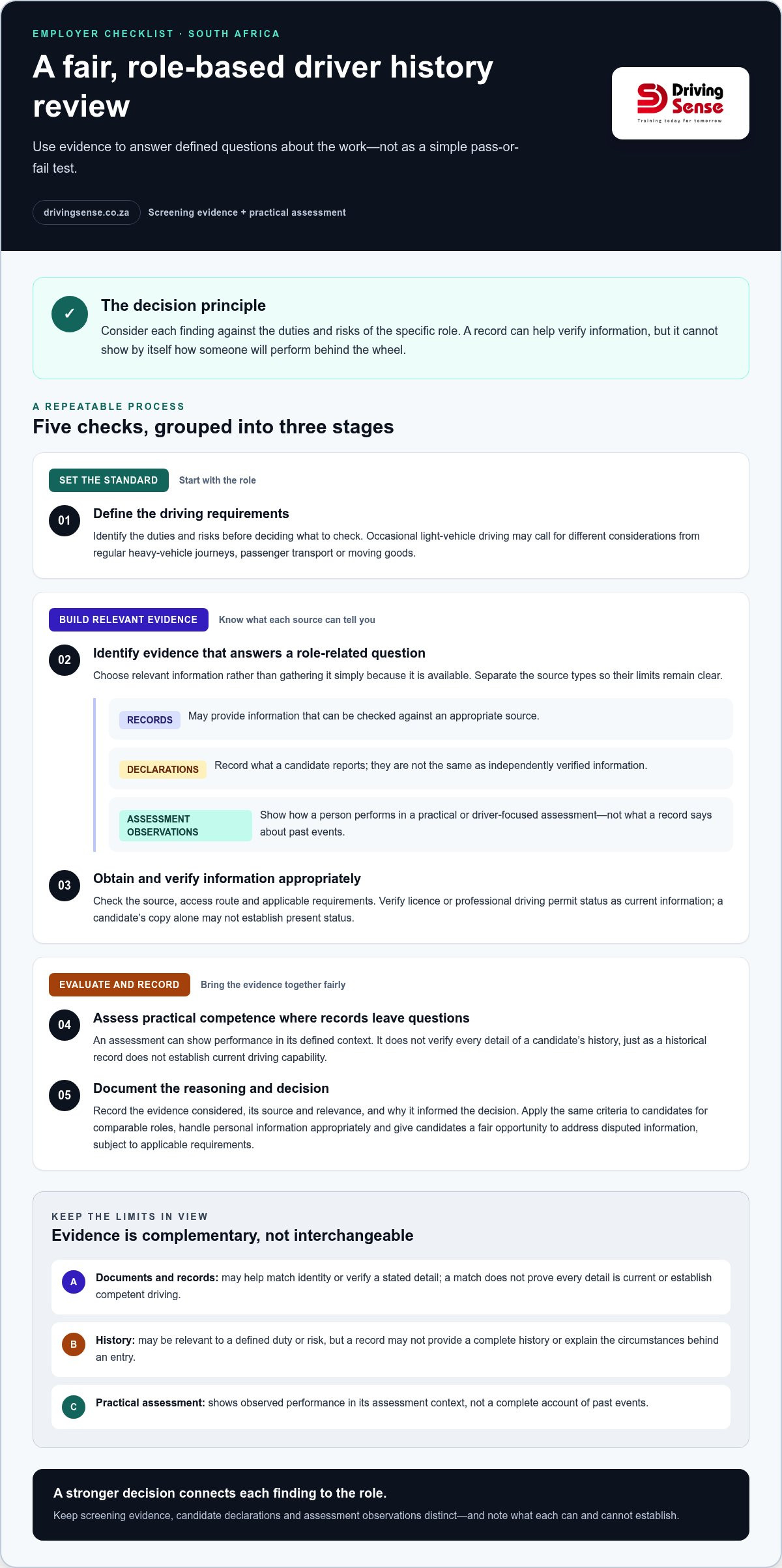
Employer checklist for driver history verification in South Africa
A repeatable process begins with the role, not a generic list of checks. For fleet employers, that means defining the driving work and deciding what evidence is needed for a fair, job-related decision. Follow the sequence below to keep screening focused and ensure that follow-up is recorded.
Before screening: define the role and process
- Define the duties. Record how driving fits into the position, the vehicle context and the responsibilities involved. Identify any relevant licence, permit or qualification requirements for those duties.
- Select relevant evidence. Decide which information can answer a specific role-related question. Avoid adding checks simply because they are available; each step should have a stated purpose.
- Explain the process. Tell candidates what information you intend to obtain, why it is relevant and how it will inform the decision. Before collecting or sharing personal information, verify the current consent and privacy obligations that apply to the process.
After screening: verify, assess and document
- Check the information. Match findings to the candidate and note the source and date of each verification. Treat an apparent mismatch as an issue to clarify, not as an established fact.
- Follow up appropriately. Give the candidate a fair opportunity to explain or correct disputed information, subject to applicable requirements. If the evidence leaves a practical capability question unanswered, consider an appropriate driver assessment.
- Record the decision. Explain which evidence was considered, why it was relevant to the role, what discrepancies arose, what follow-up took place and how the findings informed the outcome.
Define the duties, select relevant evidence, obtain it appropriately, verify the findings, assess any remaining capability questions and document the decision. This gives driver history verification South Africa employers conduct a clear framework without assuming that every role needs identical checks.
Quick decision-record checklist
- Role duties, vehicle context and relevant requirements
- Evidence reviewed, with source and verification date
- Reason each item was relevant to the position
- Discrepancies, candidate response and follow-up
- Any assessment considered and the decision rationale
- How information will be handled in line with verified requirements
Consistency matters. Use the same role-based criteria for candidates applying for comparable positions, while recording why a particular case needs different follow-up. Keep the decision record factual: distinguish verified information from declarations and assessment observations, and avoid conclusions the evidence cannot support. Confirm current privacy and record-handling requirements rather than relying on an assumed retention period or informal practice.
Driving Sense provides pre-employment screening and driver-focused assessment services for organisations looking to connect screening with an assessment of driving capability.
How Driving Sense supports pre-employment driver screening
Once an employer has defined the role and established a consistent checklist, the next step is to consider how screening evidence can be viewed alongside the candidate’s driving capability. Driving Sense provides pre-employment screening and professional driver evaluations, as well as driver training, profiling and assessments. These services provide complementary, driver-focused support for organisations making placement decisions.
Connecting history verification with driver assessment
Driver history verification South Africa employers undertake can help establish whether relevant information and documents support what a candidate has stated. It does not, by itself, demonstrate how that person will perform in the duties of a particular position. Driver profiling and assessment address a different question by providing insight in a driver-focused context. Consider both forms of evidence when the role calls for a view of documented history as well as practical capability.
This distinction helps clarify what each part of the process can contribute. Screening informs what is known from relevant information, while assessment can help address questions about demonstrated capability. Neither should be treated as a substitute for the other, and both should be interpreted in relation to the duties being considered. A pre-employment driver screening buying guide can help organisations consider how these elements fit into a structured hiring process.
Driving Sense was founded in 2006. Founder Natalie Rodrigues has 11 years of experience at Super Group’s Truck Rental Division, and the company provides professional driver evaluations alongside driver training, profiling and assessments. Employers can bring screening and driver assessment together rather than treating document review as a complete picture of suitability.
Plan a consistent national screening approach
For organisations operating across South Africa, a shared role-based framework can make recruitment decisions more consistent. That does not mean every position needs identical checks. Instead, establish common principles for defining driving duties, selecting relevant evidence and recording decisions, then adapt the process to each role’s vehicle context and responsibilities.
Driving Sense serves organisations nationally. Its pre-employment screening and driver-focused assessment services can support employers developing an approach that reflects their operational needs. Employers remain responsible for applying relevant criteria fairly and handling candidate information appropriately.
Make driver screening part of sound placement decisions
Driver requirements can change as an organisation adjusts its operations, vehicles or responsibilities. Treat the screening framework as part of workforce governance: review it when a role changes and make sure the evidence sought still answers relevant questions about that position. This helps keep decisions aligned with operational needs instead of letting old criteria become the default for every appointment.
A considered approach to driver history verification south africa can establish a consistent basis for future reviews, provided findings are interpreted fairly and personal information is handled appropriately. The objective is not to eliminate every uncertainty. It is to make placement decisions using relevant evidence and a clear understanding of what that evidence can establish.
Driving Sense supports organisations with pre-employment screening, professional driver evaluations, and driver training, profiling and assessments. Contact Driving Sense to discuss a role-based driver screening approach for your organisation.
Frequently Asked Questions
What does driver history verification in South Africa involve?
It involves checking relevant driving-related information against the requirements of a particular position, using information that can appropriately be accessed and attributed to the candidate. For a vehicle-specific role, for example, an employer may need to establish whether the candidate’s stated licence information aligns with the role’s requirements. The scope can differ between positions. Record each verification with its source and the date checked.
Can an employer verify a candidate’s driving history in South Africa?
An employer can seek to verify relevant information, provided the process follows applicable requirements for access, consent and personal-information handling. Before requesting or using candidate information, define why it is needed for the role and explain its intended use. Do not assume that a source provides a complete record. If information appears inconsistent, give the candidate an appropriate opportunity to clarify it before relying on it in a hiring decision.
Is a driving licence check enough when hiring a commercial driver?
Not necessarily. A licence check may help establish whether the candidate has information relevant to the vehicle and duties, but it does not establish every capability a commercial role may require. Identify any role-relevant licence class or professional permit requirements, then consider whether further evidence is needed about the work itself, such as handling the assigned vehicle or carrying out the required driving tasks.
What is the difference between driver history verification and a driver competency assessment?
Driver history verification concerns relevant information about a candidate’s documents or past record. A competency assessment concerns demonstrated performance in an assessment setting. A document check may help verify a stated licence detail, while an assessment might observe vehicle control or responses to task-related conditions. These forms of evidence support different conclusions, so be clear about the question each one is intended to answer.
How should an employer handle a discrepancy in a driver’s history check?
Pause before drawing a conclusion. Check whether the discrepancy could result from a data-entry error, a difference in recorded names or an outdated document, and establish whether the information relates to the candidate. Record the issue and the steps taken to clarify it. Give the candidate a fair opportunity to respond, then base any decision on verified, relevant information and applicable requirements.
How can a business make driver history screening consistent across South Africa?
Use a shared screening framework with role profiles, common decision criteria and a standard record for documenting evidence and outcomes. Apply the same principles across sites while allowing checks to reflect differences in vehicle types and driving duties. Assign responsibility for reviewing exceptions and periodically assess whether the process remains relevant. This makes decisions easier to compare and helps prevent local practices from drifting away from organisational standards.

Pingback: Driver Competency Assessment in South Africa: What Businesses Need to Know – Driving Sense