
A driver’s style can have a measurable effect on fuel use: according to the U.S. Department of Energy, aggressive driving can lower fuel economy by 15%–30% at highway speeds. For South African organisations, learning how to improve driver behaviour and reduce fuel costs starts with practical habits such as smoother acceleration, controlled braking and less unnecessary idling.
Fuel use depends on more than the vehicle. Driving habits, route choices and consistent fleet-wide practices all play a part. Clear expectations and useful performance data can help turn individual improvements into a practical management approach.
This article explains how efficient driving can reduce fuel consumption and support better environmental outcomes, what fleet data can reveal about areas for improvement, and how driver engagement can sustain progress. It also considers how structured driver training can help employees understand the connection between everyday decisions behind the wheel, vehicle performance and fuel use.
Key Takeaways
- Use fleet performance data to identify driving patterns and routes where fuel use may be improved.
- Build smoother acceleration and braking into driver expectations to support more efficient journeys.
- Monitor driver engagement and progress so efficient practices can be reinforced consistently.
- Include tyre pressure checks in fleet maintenance routines, as properly inflated tyres support fuel efficiency.
- Review speed, idling and route choices together to understand how day-to-day decisions affect fuel consumption.
1. Environmental benefits of efficient driving
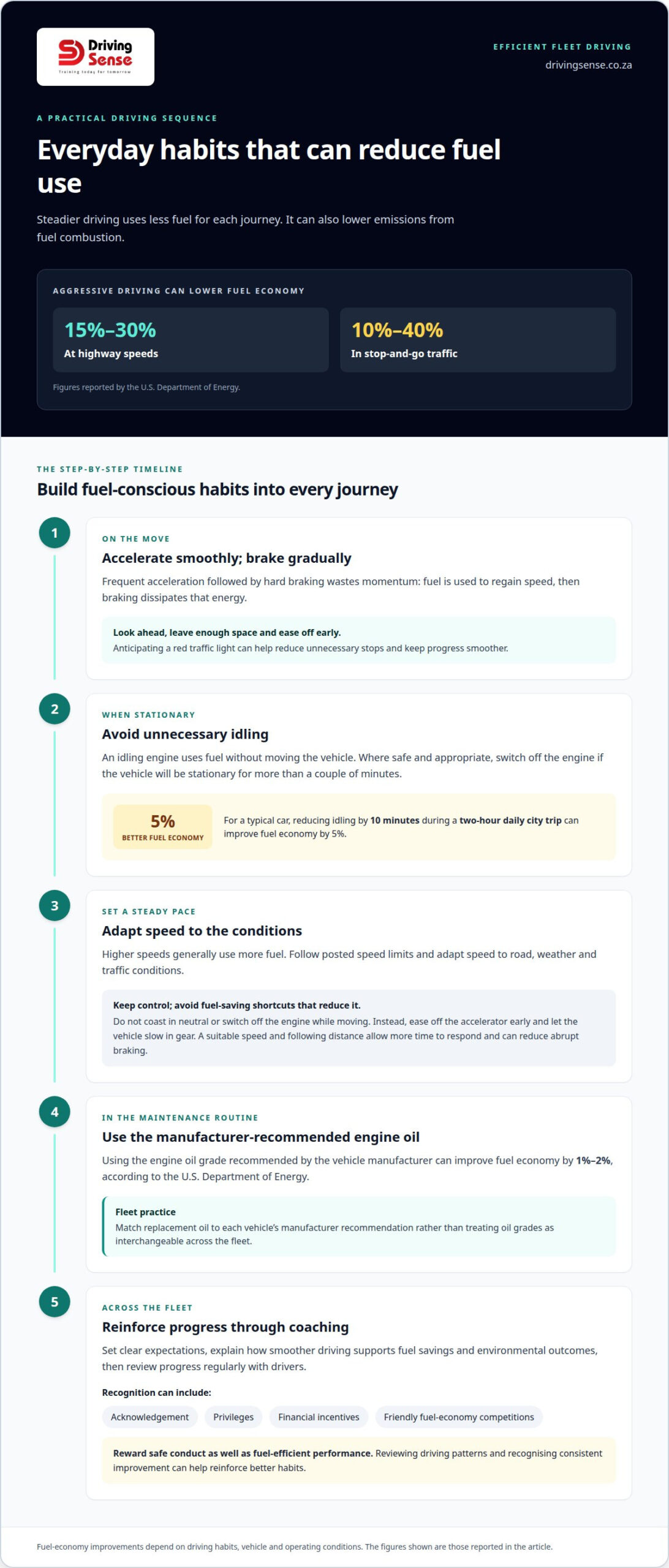
Efficient driving reduces the fuel needed for each journey, which can also lower emissions from fuel combustion. The U.S. Department of Energy reports that aggressive driving can lower fuel economy by 15%–30% at highway speeds. In stop-and-go traffic, aggressive driving can lower fuel economy by 10%–40%, according to the U.S. Department of Energy. These figures show why driving habits matter alongside vehicle choice.
Frequent acceleration followed by hard braking wastes momentum: the engine uses fuel to regain speed, and braking dissipates that energy. Drivers can take a steadier approach by looking ahead, accelerating smoothly and leaving enough space to slow gradually. Near traffic signals, anticipating a red light can reduce unnecessary stops and help maintain smoother progress.
Idling also uses fuel without moving the vehicle, so avoid leaving an engine running during avoidable stationary periods. For a typical car, reducing idling by 10 minutes during a two-hour daily city trip can improve fuel economy by 5%. A practical fleet habit is to switch off the engine when a vehicle will be stationary for more than a couple of minutes, where safe and appropriate.
Vehicle maintenance supports these driving improvements. Using the engine oil grade recommended by the vehicle manufacturer can improve fuel economy by 1%–2%, according to the U.S. Department of Energy. A fleet maintenance process should therefore match replacement oil to each vehicle’s manufacturer recommendation, rather than treating oil grade as interchangeable across the fleet.
In South Africa, drivers should follow posted speed limits and adapt their speed to road, weather and traffic conditions. Higher speeds generally use more fuel, while a suitable speed and following distance give drivers more time to respond and reduce abrupt braking. A fleet policy can make safe, steady driving the standard, rather than focusing only on journey times.
Coasting in neutral or switching off the engine while moving can reduce a driver’s control, so neither should be used as a fuel-saving technique. Instead, drivers can ease off the accelerator early and let the vehicle slow in gear, maintaining control and avoiding sudden manoeuvres.
Managers can reinforce better habits by reviewing driving patterns and recognising consistent improvement through appropriate incentives, such as acknowledgement, privileges, financial incentives or friendly fuel-economy competitions. Set clear expectations, explain how smoother driving supports fuel savings and environmental outcomes, then review progress through regular coaching. Recognition is most effective when it rewards safe conduct as well as fuel-efficient performance.
2. Fleet performance data and fuel efficiency
Fuel records become useful when fleet managers compare like with like. Track litres purchased, distance travelled and fuel efficiency for each vehicle, then review the figures over consistent operating periods. Litres per 100 kilometres can help distinguish a change in consumption from a change in mileage. Keep vehicle type, route demands and operating conditions in view when interpreting results.
To determine how to improve driver behaviour and reduce fuel costs, compare fuel consumption and fuel spend against a baseline, while accounting for distance travelled and the vehicles’ work. Review litres per 100 kilometres alongside fuel expenditure in rand, rather than treating a lower total fuel bill as proof of improved efficiency. To assess driver performance, combine these measures with indicators such as idling, speeding, harsh braking and rapid acceleration.
Fuel-card reports can help fleet managers spot refuelling patterns and possible changes in maintenance frequency. Telematics can add context by recording driving behaviour, while in-vehicle feedback can alert drivers to actions such as rapid acceleration. Use these records to identify recurring patterns, then discuss specific examples in coaching instead of relying on a single overall score.
Vehicle choice also affects fleet performance. Match each vehicle to its task: an over-specified vehicle may use more fuel than the work requires, while an under-specified one may not suit its load or route. Review equipment and cargo distribution, too. Carrying only essential items and arranging loads evenly can reduce unnecessary weight and mechanical strain.
Case studies illustrate how coaching outcomes can be measured. CEE Fresh Food Logistics reduced consumption from 24.21 to 22.29 litres per 100 kilometres after introducing coaching. Within three months of implementation in April 2023, the operation reported saving 7,507 litres of fuel monthly. This example connects a measurable efficiency change with a follow-up fuel-volume measure.
Velox Trans Europe reported a fuel-consumption improvement of 1.5 litres per 100 kilometres and monthly fuel savings of 5,250 litres across an operation covering 350,000 kilometres per month and 48 vehicles. These figures show why fleet-wide results should be read alongside distance and fleet size. They are case-specific outcomes, not a universal forecast for South African operations.
Reviewing these measures helps managers understand how to improve driver behaviour and reduce fuel costs across their own fleet. Establish a baseline, set an efficiency target, and review progress with drivers at regular intervals. Pair performance data with practical coaching so drivers understand which behaviours need attention and how improvement will be assessed. For organisations seeking structured support, driver training can help build consistent, fuel-conscious driving practices. Programme costs depend on fleet size, operational requirements and training scope; the exact amount is provided in a quote for the specific case.
3. What Reduces Fuel Consumption?
Rapid acceleration makes the engine work harder to increase speed. Sudden braking then wastes that momentum, so the vehicle uses fuel to accelerate again. In a delivery fleet, repeated stop-start driving on urban routes can make these habits especially costly over time. Smoother driving reduces unnecessary speed changes and helps maintain progress through traffic.
Drivers can moderate acceleration by pressing the accelerator progressively instead of demanding rapid power from the engine. They should look ahead for queues, intersections and changing signals, then ease off early when slowing is likely. For example, lifting off sooner as traffic slows can reduce the need for sharp braking. The response must still suit road conditions and maintain safe control.
Braking behaviour matters for vehicle wear as well as fuel use. Heavy reliance on service brakes instead of engine braking can increase brake wear by up to 80%. Drivers can use engine braking to help control the vehicle and reduce reliance on service brakes, particularly when slowing gradually. This means easing off the accelerator and allowing the engine to help manage speed, rather than selecting neutral or switching off the engine.
Smooth braking starts with observation. An appropriate following distance gives drivers more time to respond when traffic slows. Near several traffic signals, anticipating a stop can help prevent last-minute braking and a forceful restart. Drivers must still brake promptly when needed to protect people and prevent collisions. Fuel efficiency never takes priority over safe control.
Fleet managers can make these behaviours concrete in driver guidance. Explain what progressive acceleration and controlled braking look like when leaving a depot, joining moving traffic or approaching a queue. Use familiar route examples, then coach drivers on observed patterns rather than relying on general instructions. Telematics can reveal recurring harsh acceleration or braking; follow-up discussions can explore the conditions behind each event.
Make smooth starts and gradual speed changes part of routine driver coaching. Review whether loading, delivery schedules or route conditions create pressure for abrupt manoeuvres, and address those operational causes alongside individual habits. Set a practical fleet standard: anticipate, maintain control, accelerate progressively and slow smoothly. Ongoing observation and performance data can show whether these practices are becoming routine.
4. Monitoring driver engagement and progress
Monitoring turns a fuel-efficiency policy into observable fleet practice. Set a baseline for fuel use, distance travelled and relevant driving events, then compare subsequent results under similar operating conditions. A change in litres per 100 kilometres can indicate progress, while traffic, route changes and vehicle use help explain fluctuations. Review patterns over time rather than judging performance from one journey.
Fleet telematics can record behaviours such as rapid acceleration and provide real-time alerts. Managers can use the observations to identify recurring patterns and discuss specific journeys during coaching. If harsh acceleration occurs repeatedly on a delivery route, for example, review the traffic conditions and driving response together. This turns monitoring into practical action instead of treating a score as a complete explanation.
Assess engagement by combining vehicle data with regular discussions and clear expectations. Share relevant feedback, recognise sustained improvement and agree on the next behaviour to address. If harsh events decrease but fuel use does not, review route demands and vehicle operation before deciding what coaching comes next. Consistent follow-up helps make efficient habits part of daily fleet routines.
Include fuel-card reports in fuel-use monitoring. They can reveal refuelling patterns and changes in maintenance frequency. Compare them with distance travelled and vehicle activity to spot anomalies or areas for closer review. For instance, an increase in fuel purchased without a corresponding operational change may prompt a review of routes, idling or vehicle condition.
Tyre pressure is another measurable factor. Keeping tyres properly inflated can improve vehicle fuel economy by 0.6% on average, according to the U.S. Department of Energy. The same organisation reports that properly inflated tyres can improve fuel economy by up to 3%. Underinflated tyres increase rolling resistance, so the engine must work harder; check tyres regularly and maintain the pressure recommended by the vehicle manufacturer.
Tyre pressure monitoring systems can support oversight, but they should complement routine pressure checks. An alert, where available, can prompt an inspection; it does not replace maintaining the manufacturer’s recommended pressure. Assign responsibility for checks, record findings consistently and follow up when pressure falls outside the recommended level.
Review fleet results at a regular, defined interval and communicate what the data shows. Compare fuel efficiency, driving events and operational context, then choose a practical focus for the next review. Connected vehicles can provide useful feedback, but driver engagement depends on explaining why monitoring takes place and using the findings constructively. This helps fleets assess progress without mistaking normal traffic or workload variations for changes in driving behaviour.
5. Driver behaviour and fuel consumption
Fuel consumption reflects how drivers use speed, acceleration, gears and vehicle momentum throughout a journey. The U.S. Department of Energy states that fuel economy typically decreases significantly at speeds above 50 miles per hour. In South Africa, fleet guidance should therefore emphasise a steady, appropriate speed for the road, rather than treating faster travel as a way to improve productivity.
Which driving behaviours increase fuel consumption in South Africa? Speeding, unnecessary idling, frequent gear changes, harsh acceleration and braking, and circuitous routes can all increase fuel use. Their effects vary with traffic, vehicle type and journey conditions, so reviewing several behaviours gives fleet managers a more useful picture than focusing on speed alone.
Gear selection is one part of the picture. Frequent or improper shifting can make the engine work harder than necessary, particularly when drivers accelerate aggressively or use an unsuitable gear. Driver guidance should explain how to select gears smoothly for the vehicle and conditions, without unnecessary revving. On routes with repeated stops, anticipating traffic can also reduce needless acceleration.
Idling uses fuel without moving the vehicle towards its destination. Where it is safe and appropriate, drivers can reduce avoidable idling by switching off the engine when a stop is expected to last more than a couple of minutes. Managers should distinguish unnecessary stationary engine use from situations where the vehicle needs to remain running for operational reasons. That makes the guidance practical rather than a rule applied regardless of context.
Route choices affect fuel use as well as driving technique. A circuitous journey adds distance, while heavy traffic can increase stopping, restarting and idling. Fleet managers can review recurring routes, delivery sequences and traffic conditions to find practical ways to reduce detours. Telematics can reveal patterns, but route data still needs operational context, including delivery windows and vehicle requirements.
Connect driving behaviour with outcomes by comparing fuel-use records against distance travelled and reviewing relevant driving events. If consumption rises on a familiar route, examine whether speed, idling, gear selection or traffic conditions changed. Use specific examples in coaching, then review the same indicators to see whether habits have shifted. This makes improvement an ongoing management process, not a one-off instruction or a target detached from daily operations.
Driver training can help employees understand how these decisions affect fuel consumption, vehicle control and safe operation. Explore driver training to support practical, consistent driving habits across your fleet.
Driving Sense: Driver Training
Driving Sense provides Driver Training for organisations looking to strengthen safe, fuel-conscious driving practices. Training can support businesses whose fleet data points to recurring behaviours such as harsh acceleration, unnecessary idling or inefficient gear changes, helping drivers connect everyday decisions with vehicle use and fuel consumption.
Training is a practical next step when performance reviews show that guidance alone has not led to consistent habits, or when an organisation wants to set shared expectations across its drivers. Training can address smoother driving, anticipating traffic and safe techniques suited to operational needs, keeping efficiency aligned with vehicle control and workplace safety.
To reinforce these practices through structured driver development, contact Driving Sense to discuss Driver Training.
Make efficient driving part of daily operations
A practical plan for how to improve driver behaviour and reduce fuel costs should be part of routine fleet management, not a temporary initiative. Set a clear operational priority, use performance reviews to guide coaching and give drivers consistent expectations that support efficiency and safe vehicle control. As habits develop, managers can use the same measures to identify where further guidance would help.
Driving Sense offers Driver Training, Emergency Safety Training and Compliance Training to support organisational training needs. Driver Training is a relevant next step when a fleet needs structured support to translate fuel-conscious practices into consistent workplace behaviour. Contact Driving Sense to discuss the training needs of your organisation and plan a practical next step for your drivers. Steady attention to driver development can help establish a more accountable and efficient approach across your fleet.
Frequently Asked Questions
What Reduces Fuel Consumption?
Fuel consumption can fall when vehicles are matched to their assigned work and journeys are managed as part of an operating system. Dispatchers can group nearby deliveries, avoid sending vehicles over routes already covered and account for loading needs before departure. This can reduce unnecessary changes in pace and vehicle use. Review fuel records alongside distance travelled and completed tasks, so operational changes are not mistaken for improvements in driving behaviour.
What eco-driving techniques help reduce fuel costs?
Eco-driving combines anticipation with choices suited to the vehicle and conditions. Drivers can look further ahead, maintain a suitable gear and avoid unnecessary acceleration when approaching a known queue or incline. In South Africa’s varied driving conditions, the right response may differ between urban traffic, open roads and changing road surfaces. Managers can use route-specific scenarios in coaching so drivers practise these principles without compromising control or safety.
How much fuel can smoother acceleration and braking save?
Better driver behaviour can improve vehicle fuel efficiency by 3–11%. To assess the effect in a particular fleet, compare fuel consumed per distance travelled over comparable operating periods, using the same vehicle groups where practical. Record relevant changes in workload, route and vehicle use alongside the results. This gives managers a more useful basis for discussing whether smoother driving is contributing to improved efficiency.
What tyre pressure and vehicle maintenance practices improve fuel efficiency?
Keep tyres at the pressure recommended by the vehicle manufacturer and include pressure checks in scheduled fleet maintenance. Record checks and follow-up actions so recurring pressure loss can be addressed. Maintenance planning should also follow each vehicle’s service requirements and the engine oil grade specified by its manufacturer. Consistent records help fleet managers identify unresolved issues and distinguish maintenance-related changes from differences in driving or operating conditions.
How can route planning and reducing idling lower fuel costs?
Route planning can reduce unnecessary distance, detours and traffic delays, while dispatch coordination can prevent vehicles travelling separately to nearby destinations. Compare planned routes with completed journeys to identify repeated diversions or delays that operations can address. For idling, distinguish avoidable stationary engine use from legitimate operational needs, then set clear guidance for drivers. This makes it easier to assess fuel records in the context of the work.
What fuel-saving incentives can employers use to improve driver behaviour?
Employers can recognise efficient driving through acknowledgement, privileges, financial incentives or friendly competitions. Keep incentives constructive by comparing performance across similar routes and vehicle duties, rather than rewarding the lowest fuel use without context. Include safe driving expectations in the assessment so drivers are not encouraged to take risks to improve a score. Clear criteria and regular feedback help employees understand which practices the organisation values.
