

What if the course that looks most comprehensive is still the wrong fit for your operation? Searching for dangerous goods training south africa is only the first step. Employees who drive, load, handle or oversee dangerous goods have different responsibilities and exposure risks, so a generic course may leave important competency gaps.
Providers can differ in course scope, delivery format and how they assess or document learning. Your organisation needs a clear way to decide who requires training, what each role must be able to do, and when knowledge should be reviewed. This guide explains how to match training to job duties and operational risks, compare providers and delivery options, and check what evidence of learning or competence is provided. It also outlines a practical training-planning process for South African operations, while recognising that not every workforce needs the same programme.
Key Takeaways
- Map training needs to employees’ actual tasks and exposure risks, rather than relying on job titles alone.
- Use role-specific competencies to check whether training covers safe procedures, hazard communication, handling controls and incident escalation.
- When comparing dangerous goods training south africa options, examine course relevance, trainer experience, delivery format, assessment and documentation.
- Choose between on-site workshops and dedicated training facilities by considering workforce needs and operational requirements.
- Driving Sense provides dangerous goods training for organisations across South Africa. Discuss delivery arrangements and content in relation to your organisation’s requirements.
Dangerous goods training in South Africa: who needs it and why?
Dangerous goods training prepares employees to understand and carry out the safe handling, storage or transport of regulated goods within the scope of their responsibilities. The goods, hazards and necessary controls vary by task. The global overview of Dangerous goods explains the broad classification context. Employers then need to establish which South African requirements apply to their specific materials and activities.
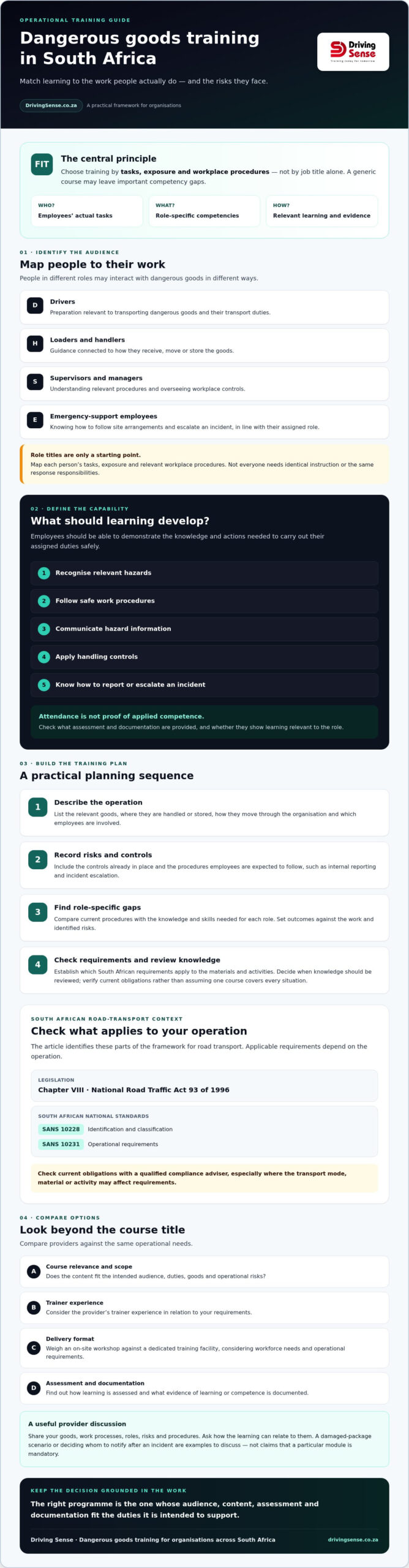
Effective training supports worker safety, incident prevention and consistent operational controls. It can also help an organisation demonstrate that it has considered relevant responsibilities and risks. For road transport, South Africa’s framework includes Chapter VIII of the National Road Traffic Act 93 of 1996 and relevant South African National Standards, including SANS 10228 for identification and classification and SANS 10231 for operational requirements. Applicable requirements depend on the operation. Verify current obligations rather than assuming one course covers every situation.
Which employees may need dangerous goods training?
Start with the work, not the job title. Drivers may need preparation relevant to transporting dangerous goods. Loaders and handlers may need guidance related to how they receive, move or store them. Supervisors and managers may oversee procedures, while employees supporting emergency response may need to know how to follow site arrangements and escalate an incident.
Some employees handle goods directly; others affect safety through planning, oversight or support. Map each role to its tasks, exposure and relevant workplace procedures. This helps you decide whether training should cover practical handling, transport responsibilities, supervision or another defined need. It also avoids assuming that everyone in a broad job category needs identical instruction. For organisations hiring drivers, a separate pre-employment driver screening process in South Africa can help assess candidate information and practical competence against the demands of the role.
What should South African employers establish first?
Before comparing dangerous goods training south africa programmes, document how the operation works. List the relevant goods, where they are handled or stored, how they move through the organisation, which employees are involved and what controls are in place. Include the procedures employees are expected to follow, such as internal reporting and incident escalation.
Next, identify gaps between current procedures and the knowledge or skills required for each role. Check applicable legislation and standards with a qualified compliance adviser, particularly where the transport mode, material or activity may affect requirements. This review gives providers useful context and gives decision-makers a consistent basis for comparing course scope. Do not assume that one course or certificate suits every employee. Confirm that the audience, content and assessment approach fit the duties the training is intended to support.
What competencies should dangerous goods training develop?
Training outcomes should reflect employees’ tasks and the hazards identified in the employer’s risk review. A useful test is straightforward: employees should be able to demonstrate the knowledge and actions needed to carry out their assigned dangerous goods duties safely. Course attendance alone does not show that a worker can apply procedures in practice.
For dangerous goods training south africa programmes to support consistent operations, learning should connect hazard information to workplace controls. Depending on employees’ responsibilities, this may include recognising relevant hazards, following safe work procedures, communicating hazard information, applying handling controls and knowing how to report or escalate an incident. Emergency-response content should match each person’s assigned role and the organisation’s procedures. It should not suggest that every employee has the same response responsibilities.
Match learning outcomes to operational duties
Consider how different roles interact with goods and procedures. Drivers may need learning relevant to their transport duties, while handling teams need instruction connected to the tasks they perform. Supervisors may need to apply or monitor workplace controls, and compliance personnel may oversee records or procedures. Set outcomes against the operation’s risks, rather than assuming them from a job title or generic course description.
Ask providers how they can relate learning to your goods, work processes and likely scenarios. For example, a practical exercise might ask a learner to identify the appropriate workplace procedure when a package is damaged, or explain whom to notify if an incident occurs. These are examples to discuss, not claims that a particular module is mandatory. Requirements depend on the operation and should be checked against current applicable rules. For air transport, consult the South African Civil Aviation Regulations Part 92 and confirm which provisions apply to the roles involved.
Awareness, task competence and assessment
Awareness training can help employees understand hazards and reporting routes, but it may not prepare someone to perform a specific handling, transport or oversight task. Ask what the programme is designed to equip each learner to do, and whether it includes enough task-focused practice for the risks identified by the employer. If your teams are also weighing hazard-awareness courses, this guide to HAZCHEM training in South Africa explains how that scope differs from driver-related requirements.
Before selecting a programme, clarify how learning is checked and recorded. Ask whether an assessment is included, what evidence of participation or competence is provided, and whether follow-up or refresher arrangements are available. Confirm assessment and certification details for the specific programme rather than assuming they are included. Organisations considering tailored delivery can discuss their requirements with Driving Sense’s dangerous goods training team.
How to compare dangerous goods training providers and formats
Compare providers against the same requirements, rather than relying on course titles or broad assurances. For dangerous goods training south africa, request the proposed syllabus, intended learner roles and relevant trainer experience. Ask how the content relates to your goods, duties and workplace procedures. A provider should be able to explain what the programme covers and where its scope may not meet your needs.
Consider delivery, assessment and records alongside course relevance. Separate what the provider has confirmed from what still requires written agreement, especially if procurement depends on specific outcomes or documentation. Before booking, record the agreed scope, delivery arrangements and any exclusions.
On-site workshops or dedicated training facilities?
The right format depends on participant access, operational disruption and whether it would be useful to discuss procedures in their workplace context. An on-site workshop may make it easier to relate learning to local processes. A dedicated facility provides a separate training setting. Either option may suit a shared cohort, or the workforce may need role-specific sessions. Confirm the venue, equipment, participant requirements and operational arrangements directly with the provider.
| Consideration | On-site workshop | Dedicated training facility |
|---|---|---|
| Workplace context | May allow discussion of organisational procedures and work settings. | Workplace examples can be discussed, but the setting is separate from the operation. |
| Participant access | Consider how attendance will affect work schedules and site activity. | Consider travel, scheduling and how employees will be released to attend. |
| Practical arrangements | Confirm suitable space, equipment and site requirements. | Confirm facility arrangements, equipment and participant requirements. |
Questions to ask before selecting a provider
Request the proposed syllabus and learning outcomes. Ask how the trainer’s experience relates to the work your employees perform. Clarify whether examples can reflect your goods and procedures, and whether one cohort or separate role-based sessions would be more suitable. These questions help you compare providers on practical relevance, not just presentation format.
- How are attendance, assessment results and completion records documented?
- Is formal assessment or certification included, and what evidence is issued?
- Are refresher or follow-up arrangements available, and what do they include?
- Which requested elements are confirmed, and which require separate agreement?
Confirm answers in writing before procurement, especially when assessment, certification or refresher arrangements affect your internal records. Driving Sense offers dangerous goods training for organisations, with content tailored to organisational requirements and delivery that can be arranged as on-site workshops or at dedicated training facilities. Discuss which arrangements may suit your workforce and operational needs.
How to plan dangerous goods training across a South African organisation
A structured plan helps decision-makers connect training investment to workplace risk, operational continuity and compliance objectives. For dangerous goods training south africa, consider relevant activities across the organisation while allowing for differences in employee duties and working arrangements.
A practical training-planning sequence
- Map activities and controls. Record the dangerous goods handled, stored or transported, where those activities take place, which procedures apply and what controls are in place.
- Map roles to tasks. Identify employees who perform, supervise or support each activity. Note how their duties expose them to hazards or require them to follow specific procedures.
- Prioritise training needs. Use your risk review to identify where knowledge or task competence needs attention. Set priorities by responsibility and assessed need, rather than job title alone.
- Agree the programme scope. Define the intended learning outcomes, participant groups, delivery arrangements and evidence your organisation needs. Confirm these details with the provider, including any assessment or completion records.
- Schedule and evaluate delivery. Plan sessions to reach employees across the organisation without overlooking operational coverage. After training, review records and feedback, then assign follow-up actions where gaps remain.
For a dispersed workforce, coordinate delivery around employee access and business operations, and confirm arrangements directly with the provider. Driving Sense can discuss organisational requirements and offers dangerous goods training through on-site workshops or dedicated training facilities.
Records, refreshers and continuous improvement
Keep records in line with your organisation’s processes and any verified requirements that apply. Depending on the programme, useful records may include attendance, documented learning outcomes, assessment results where applicable, identified gaps and follow-up actions. Confirm what the provider supplies. Do not assume certification or refresher training is included.
Review training needs when goods, employee duties, procedures or assessed risks change. Incidents, audit findings and employee feedback can also show where procedures need clarification or further learning may be appropriate. Check legal and standards requirements with a qualified compliance adviser, rather than treating a generic refresher interval as a substitute for verification.
After delivery, check whether the right employees attended, whether learning outcomes were evidenced, whether gaps were recorded, and whether follow-up actions have an owner. Apply this checklist consistently, document the review and use the findings to inform the next training cycle. To discuss training arrangements for your organisation, contact Driving Sense about dangerous goods training.
Choosing a dangerous goods training partner for your organisation
A suitable partner should be able to discuss how training could address your workforce’s duties and operational risks, rather than relying on a course title alone. Use a consistent selection framework: assess role fit and relevance to your procedures, compare delivery options, and confirm how learning is assessed and documented. For dangerous goods training south africa, also verify legal or standards requirements for your specific activities with a qualified compliance adviser.
How Driving Sense can support organisational training
Driving Sense provides dangerous goods training as part of its corporate safety and compliance offering to organisations across South Africa. Founded in 2006, the company has over 20 years of experience and can discuss how training content may be tailored to organisational requirements. Delivery can be arranged as an on-site corporate workshop or at a dedicated training facility, subject to confirmation with the provider.
Before procurement, confirm the proposed course scope, intended audience and learning outcomes, as well as the trainer’s relevant experience and any assessment or documentation arrangements. Check these details for the specific programme. Do not assume accreditation, certification or refresher provisions are included. Written confirmation helps your organisation assess whether the proposed training meets its operational and record-keeping needs.
Prepare for a training discussion
A focused discussion is more productive when decision-makers can describe the work the training needs to support. Prepare information about:
- Employee roles and the dangerous goods activities they perform or oversee.
- Current workplace procedures, controls and any training needs identified through risk review.
- Operational constraints, preferred delivery arrangements and the learning outcomes sought.
- The assessment evidence and completion records your organisation needs, along with any follow-up questions.
This preparation gives the provider context to discuss options and helps your organisation judge whether the proposed programme is relevant, practical to schedule and appropriately documented. It also creates a clearer basis for agreeing scope before training begins.
For a considered next step, discuss dangerous goods training for your organisation with Driving Sense, including your workforce requirements and suitable training arrangements.
Build a training plan that fits your operation
Effective dangerous goods training south africa starts with a clear view of who does what, which risks they face and what they need to demonstrate in their roles. Match learning outcomes to actual duties, then compare providers on operational relevance, delivery arrangements, assessment and the records they supply. This gives your organisation a sounder basis for planning training and addressing competency gaps.
Review training as work changes. New activities, revised procedures, incidents or audit findings can signal that employees need further guidance. Keep records and follow-up actions connected to your wider safety processes.
Driving Sense provides dangerous goods training as part of its corporate safety and compliance offering. Founded in 2006, the company has over 20 years of experience. Corporate workshops or sessions at dedicated training facilities can be arranged. Discussing your workforce’s duties, operational requirements and preferred delivery approach can help establish whether the programme is a suitable fit.
Discuss dangerous goods training for your organisation with Driving Sense and take a considered next step towards safer, more consistent operations.
Frequently Asked Questions
Who needs dangerous goods training in South Africa?
Employees whose work involves dangerous goods may need training suited to their duties and exposure. This may include drivers, loaders, handlers, supervisors and personnel who support or oversee operations. The right scope depends on what each person does, not their job title alone. Employers should map tasks, goods, workplace procedures and existing controls before selecting a programme. This role-based approach helps distinguish employees who need general awareness from those who need preparation for specific tasks.
What does dangerous goods training cover?
Course content should reflect the goods involved, employee responsibilities and risks identified by the employer. Depending on the programme, it may cover hazard recognition and communication, safe work procedures, handling controls, transport-related responsibilities or incident reporting and escalation. Emergency-response learning should match each employee’s assigned role and the organisation’s procedures. Ask for the syllabus and learning outcomes before enrolment, as course coverage can vary and should not be assumed from the programme title.
Is dangerous goods training a legal requirement in South Africa?
Requirements depend on the goods, activity, transport mode and employee’s responsibilities. Do not assume one course satisfies every organisation’s obligations. South Africa’s road-transport framework includes Chapter VIII of the National Road Traffic Act 93 of 1996 and relevant standards. Employers should verify which current provisions apply to their operations with a qualified compliance adviser, then confirm that selected training supports those duties. Training alone does not establish compliance.
How do I choose a dangerous goods training provider?
Compare providers against consistent criteria: relevance to employees’ duties, alignment with your goods and procedures, trainer experience, delivery format, assessment and documentation. Request the syllabus, learning outcomes and details of how participation or competence is recorded. Confirm in writing whether assessment, certification, refresher training or follow-up is included. For dangerous goods training south africa, verify applicable requirements independently rather than treating a general course description as evidence of compliance.
Can dangerous goods training be delivered on-site?
On-site delivery may be an option, depending on the provider and agreed arrangements. It can make it easier to discuss workplace procedures in context, although employers should consider site access, operational disruption, suitable space and participant requirements. Driving Sense provides dangerous goods training for organisations across South Africa, with on-site workshops or sessions at dedicated training facilities available by arrangement. Confirm the proposed format, venue and any equipment or preparation needed before booking.
How often should dangerous goods training be refreshed?
There is no single refresher interval to apply to every role without checking relevant requirements and operational risks. Review training needs when goods, duties, procedures or controls change, and consider whether incidents, audit findings or employee feedback reveal gaps. Ask the provider what refresher arrangements are available, and consult a qualified compliance adviser about applicable requirements. Record the reasons for review and the follow-up actions agreed by your organisation.
Does dangerous goods training include a certificate?
Whether a certificate is issued depends on the specific programme and its arrangements, so confirm this with the provider before enrolment. Ask whether the programme includes an assessment, what completion evidence is provided, and whether records identify attendance, results or demonstrated competence. Check any stated certificate conditions, including validity or renewal, rather than assuming they apply. Keep documentation aligned with your organisation’s record-keeping processes and verified compliance requirements.

Pingback: HAZCHEM Training South Africa: What Employers and Learners Need to Know – Driving Sense