

What if a training record is complete, but workers still can’t demonstrate the skills needed to manage hazards on site? That distinction matters when selecting occupational health and safety training south africa organisations can rely on to support compliance and practical competence. Course completion is important, but so are the subject, learner readiness and fit with workplace roles. Medical fitness and the changing accreditation landscape may also affect how an organisation structures its training plan.
This guide provides a practical framework for matching training subjects to workplace risks, assessing learner readiness and planning a programme around organisational needs. It explains why attendance or a certificate alone may not establish workplace competence, and how pre-training educational assessments, such as those used by Driving Sense, can inform learner readiness. Use the steps and examples to connect compliance context, role requirements and practical skills development, rather than treating training as a record-keeping exercise.
Key Takeaways
- Choose occupational health and safety training south africa options by linking applicable requirements to workplace hazards and employee responsibilities.
- Compare programmes using consistent criteria, including needs analysis, course relevance, learner preparation and assessment.
- Use a role-to-risk-to-training matrix to identify suitable subjects, rather than treating first aid or fire-fighting as universal requirements.
- Distinguish course completion from demonstrated competence, and consider pre-training educational assessments when planning learner support.
- Build a coordinated programme by reviewing roles and risks, prioritising modules and planning employee participation across your organisation.
Why occupational health and safety training in South Africa must build compliance and competence
Workplace training needs to do more than place a course certificate on file. Employees should understand the procedures relevant to their roles and be able to apply them to their assigned tasks. When comparing occupational health and safety training south africa options, consider how each programme connects workplace requirements with practical capability.
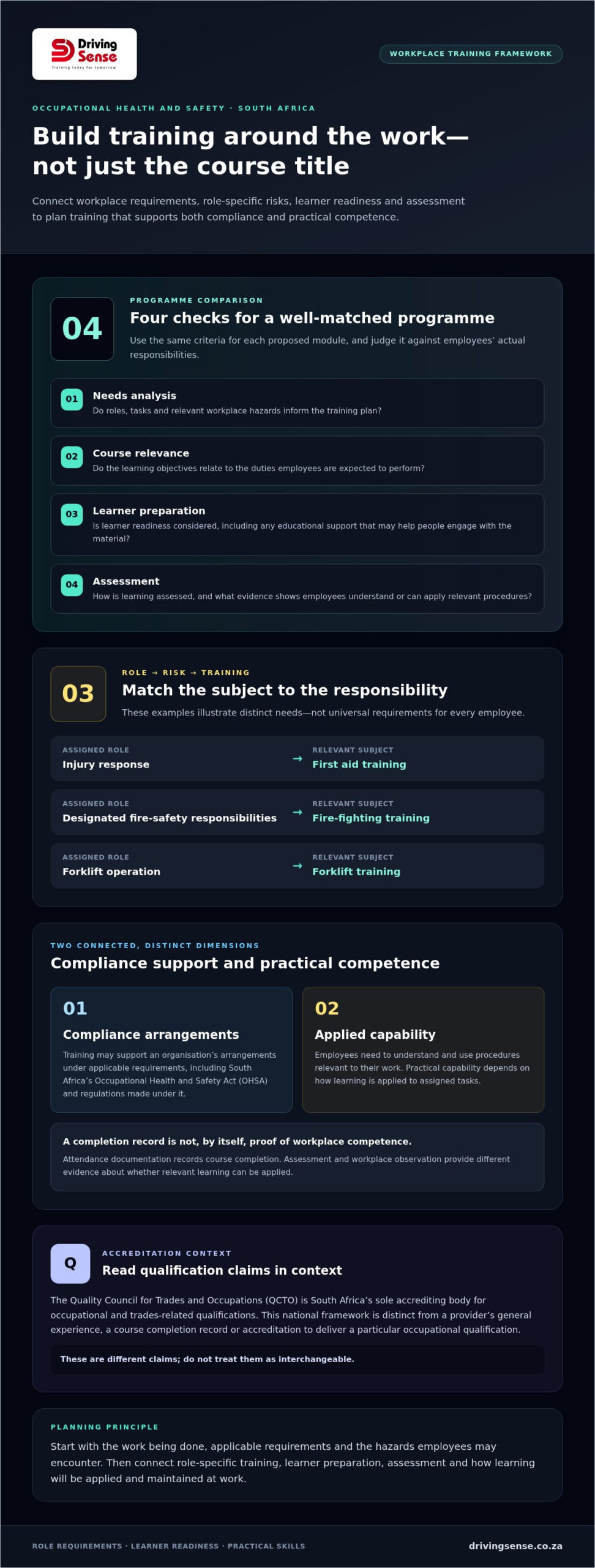
Occupational health and safety training is structured learning that equips employees with the knowledge and practical skills to perform assigned work more safely and competently. Completion records show that a learner attended or finished a course. On their own, they don’t demonstrate that the learner can apply relevant knowledge in the workplace. Compliance and competence are related but distinct: training may support an organisation’s compliance arrangements, while practical capability depends on whether employees understand and use the procedures relevant to their work.
South Africa’s legislative framework includes the Occupational Health and Safety Act (OHSA) and regulations made under it. The training an organisation needs depends on the work being done, applicable requirements and the hazards employees may encounter. Start with an analysis of roles and tasks, rather than choosing a course solely because its title sounds relevant.
What does occupational health and safety training cover?
Health and safety learning can sit alongside statutory or legislative training, with each element addressing a defined workplace need. First aid training may be relevant to employees assigned to respond to injuries. Fire-fighting training may support workers with designated fire-safety responsibilities. Forklift training is relevant to work involving forklift operation. These are distinct examples, not universal requirements for every employee. Choose subjects according to actual duties, workplace risks and responsibilities assigned to each role.
Why should employers look beyond course completion?
Training has greater practical value when learners are prepared to engage with the material and relate it to their work. Existing knowledge and learning needs may affect how readily an employee understands instructions, procedures and assessment tasks. A pre-training educational assessment can help inform learner readiness, giving an organisation information to use when planning appropriate support instead of assuming that every learner starts from the same point.
Learning also needs to connect to performance. An employee should be able to explain or demonstrate relevant procedures in a way that reflects their assigned tasks and the scope of the training and assessment. Attendance documentation records course completion; assessment and workplace observation provide different evidence about applied competence. Neither should be treated as a blanket guarantee of compliance or safer outcomes. A sound training plan links requirements, role-specific hazards, learner preparation and assessment, then considers how learning will be applied and maintained at work.
How to compare occupational health and safety training providers in South Africa
A useful comparison looks beyond course names and completion documents. When assessing occupational health and safety training south africa, consider whether programme objectives, learner preparation and assessment methods align with employees’ actual responsibilities. Apply the same criteria to each proposed module so decisions reflect operational needs, not just a broad course label.
Which criteria indicate a well-matched training programme?
Compare each programme against the work employees perform and the hazards associated with it. Use the framework below to identify how a course relates to workplace requirements and where further planning may be needed.
| Comparison area | What to assess |
|---|---|
| Needs analysis | Whether roles, tasks and relevant workplace hazards inform the proposed training plan. |
| Course relevance | Whether stated learning objectives relate to the duties employees are expected to perform. |
| Learner preparation | Whether readiness is considered, including any educational support learners may need to engage with the material. |
| Assessment | How learning is assessed, and what evidence indicates that employees understand or can apply the relevant procedures. |
Check that course objectives connect to employees’ real tasks, rather than simply repeating general safety language. Driving Sense uses pre-training educational assessments to inform learner readiness, and its training approach balances compliance with genuine skill development. For broader professional practice context, see the South African Institute of Occupational Safety and Health (Saiosh).
How should employers interpret accreditation and qualifications?
Read accreditation claims in context. The Quality Council for Trades and Occupations (QCTO) is South Africa’s sole accrediting body for occupational and trades-related qualifications. This national framework is distinct from a provider’s general experience, a course completion record or accreditation to deliver a particular occupational qualification. These are not interchangeable claims.
For employers, the practical distinction is whether the training is a short course or part of a formal occupational qualification, and what recognition applies to that specific programme. Don’t infer a provider’s accreditation status from the existence of the QCTO framework or from a general statement about training quality. Where professional standards are relevant to a role, distinguish them from the accreditation status of a qualification.
Driving Sense delivers health and safety and statutory or legislative training for organisations across South Africa. To explore its health and safety training, consider how a programme can support your organisation’s compliance requirements and practical skills priorities.
Match occupational health and safety courses to workplace roles and risks
A course title alone doesn’t show whether training fits the work. Map each role to its tasks, the hazards those tasks may involve, and the learning that supports employees’ responsibilities. This gives organisations a practical basis for prioritising occupational health and safety training south africa, without assuming that every employee needs the same specialist course.
How can employers map training to job roles?
Start with the work itself. Record employees’ routine tasks, work environments, equipment use and any assigned safety responsibilities. Then connect each role to relevant training needs, distinguishing general health and safety learning from task-specific or designated-role preparation.
The examples below show how a role-to-risk-to-training matrix can support planning. They aren’t a substitute for assessing your organisation’s actual workplace risks.
| Role or responsibility | Work-related consideration | Training to consider |
|---|---|---|
| Employees across a work area | Shared workplace procedures and hazards relevant to their tasks | General health and safety or statutory and legislative training, as relevant |
| Employees assigned first aid responsibilities | Responding within their designated first aid role | First aid training |
| Employees with fire-safety responsibilities | Supporting the organisation’s fire response arrangements | Fire-fighting or relevant emergency safety training |
| Employees who operate forklifts | Using lifting equipment as part of their work duties | Forklift training |
Use the matrix to identify who needs which learning and why. It can also reveal gaps, such as equipment responsibilities that aren’t reflected in the current training plan. The matrix supports decision-making, but it doesn’t replace a suitable risk assessment or determine legal requirements on its own.
When might specialist training fit the risk profile?
Specialist modules should relate to specific tasks or responsibilities. First aid and fire-fighting address different capability areas, so don’t treat one as a substitute for the other or automatically assign both to every employee. Likewise, forklift training is relevant to employees whose duties involve operating forklifts, not simply to everyone who works in the same organisation.
For emergency-related planning, the corporate emergency safety training guide offers a related planning reference. Review role-to-risk-to-training links when work, equipment or responsibilities change, so the programme stays aligned with operational needs.
Assess learner readiness, competence and QCTO context before choosing training
A certificate is useful evidence of course completion, but it doesn’t automatically show that an employee can apply learning to their duties. When assessing occupational health and safety training south africa, distinguish between participation, assessment results and workplace competence. Each provides different information, so consider training records alongside evidence of what learners understand and can do in their roles.
What should employers know about learner readiness?
Readiness affects how learners engage with course material and assessment. Driving Sense uses pre-training educational assessments to help inform learner readiness before training begins. The results can inform programme planning by highlighting where learners may need support to participate effectively.
Readiness checks shouldn’t be treated as a prediction of success or a substitute for assessment. They can help organisations understand learners’ starting points, particularly where a course requires employees to interpret instructions, understand procedures or demonstrate relevant knowledge. Consider readiness alongside course objectives, learner progress and the practical demands of the role.
Keep the evidence distinct: an attendance record shows participation, an assessment provides evidence against its criteria, and workplace observation may show whether relevant learning is being applied in assigned tasks. No single document proves every aspect of competence.
What does the QCTO transition mean for training buyers?
South Africa’s occupational qualifications framework has been transitioning towards QCTO accreditation for Skills Development Providers offering occupational qualifications. The Quality Council for Trades and Occupations (QCTO) is the sole accrediting body for occupational and trades-related qualifications. Keep the transition and accrediting role in mind when distinguishing occupational qualifications from other forms of workplace learning.
For buyers, the key is to identify what kind of learning is being procured. A course that supports workplace learning is not necessarily an occupational qualification, and a qualification’s national framework status doesn’t, by itself, establish that a particular provider holds accreditation to deliver it. Keep the qualification, accrediting framework and provider’s specific credentials separate in procurement records. Don’t infer one from another.
Accreditation arrangements and legal requirements can change, so verify current official wording before relying on it in procurement or compliance decisions. This is especially important when a training requirement is linked to a formal occupational qualification rather than a workplace-specific course.
Driving Sense takes a quality-focused approach that considers compliance alongside genuine skill development, with pre-training educational assessments informing learner readiness. Explore Driving Sense’s health and safety training as you assess how learner preparation and practical competence fit your organisation’s training needs.
Plan a nationwide occupational health and safety training programme with Driving Sense
A coordinated programme connects workplace priorities with training delivery across teams and locations. For occupational health and safety training south africa, account for differences in roles, hazards and learner readiness, while giving managers a clear way to prioritise modules and coordinate employee participation.
What steps help organisations organise training?
Use this sequence to turn operational information into a manageable training plan:
- Review roles and duties. Document what employees do, the equipment or work environments involved, and any specific safety responsibilities assigned to them.
- Identify relevant risks and requirements. Use the organisation’s workplace safety compliance checklist for South Africa and applicable statutory or legislative requirements to establish where training may be needed. Keep the assessment of risk distinct from the training plan itself.
- Select suitable subjects. Match learning to the work and responsibilities identified. Prioritise training according to the relevance of the hazard, the employee’s duties and any role-specific requirements, rather than enrolling everyone in every module.
- Consider learner readiness. Educational assessments before training can inform planning by indicating learner readiness and potential support needs.
- Coordinate participation and review learning. Organise employee participation around operational needs, maintain clear training records and consider how learning relates to assigned work.
This sequence gives managers a practical basis for organising a programme without assuming that one training schedule fits every team. Driving Sense provides nationwide training capability across South Africa, supporting organisations planning training for teams in different locations.
How can training support broader workforce requirements?
Occupational health and safety learning may sit alongside OHS Act compliance training and statutory and legislative training, with each subject selected according to the relevant duties. Where employees have fleet-related responsibilities, the corporate driver training buying guide provides a related planning reference. If employees’ roles involve dangerous goods, consult the dangerous goods training buying guide for that specific area. Include these subjects when the work calls for them, not simply because they appear in a general training catalogue.
A well-structured plan makes priorities clearer, supports coordinated participation and keeps training connected to organisational needs. Discuss a quality-focused training approach tailored to your organisation with Driving Sense.
Build a training plan that supports safer, more capable teams
Effective occupational health and safety training south africa organisations choose should connect compliance requirements with workplace roles, real hazards and practical skills. Match subjects to assigned duties, prepare learners to engage with the material, and assess what course completion does and doesn’t demonstrate. A clear plan helps organisations prioritise relevant modules and coordinate participation across their workforce.
Driving Sense was founded in 2006 and provides training nationwide across South Africa. Founder Natalie Rodrigues brings an 11-year tenure at Super Group’s Truck Rental Division. The company is a 100 % B‑BBEE, Level Four contributor. Its focus on compliance alongside genuine skill development supports a considered approach to organisational training needs.
Discuss a quality-focused occupational health and safety training approach with Driving Sense, tailored to your organisation’s roles, risks and learner readiness.
Frequently Asked Questions
What does occupational health and safety training cover in South Africa?
Occupational health and safety training covers learning that supports safer work, relevant workplace responsibilities and applicable statutory or legislative requirements. Subjects may include general health and safety, first aid, fire-fighting or forklift training, depending on employees’ duties and workplace risks. The right programme isn’t simply a collection of popular courses; it connects learning objectives to the work employees actually perform and the procedures they need to understand.
How do I choose occupational health and safety courses for my employees?
Start by reviewing employees’ roles, tasks, work environments and relevant hazards, then identify the learning needed for each responsibility. Compare course objectives with actual duties, and consider learner preparation and how learning will be assessed. For example, forklift training is relevant to employees whose work involves operating forklifts, whilst first aid or fire-fighting training may suit designated responsibilities. Use a risk assessment and applicable requirements to inform course selection.
Is QCTO the accrediting body for occupational qualifications in South Africa?
Yes. The Quality Council for Trades and Occupations (QCTO) is the sole accrediting body for occupational and trades-related qualifications in South Africa. Buyers should distinguish the national framework from the credentials of a specific provider, and establish whether a programme is a course or part of a formal occupational qualification before making accreditation-related decisions.
Can occupational health and safety training be tailored to different workplace roles?
Yes. Training can be planned around the different tasks, hazards and responsibilities found across an organisation. Employees with forklift operating duties, for instance, have different training needs from those assigned first aid or fire-safety responsibilities. A role-to-risk-to-training matrix can help employers organise these distinctions and prioritise relevant modules. It supports planning, but doesn’t replace a risk assessment or determine legal requirements by itself.
How can employers assess whether employees are ready for occupational training?
Employers can use pre-training educational assessments to inform their understanding of learner readiness before a programme begins. This information may help with planning and identifying where learners could benefit from appropriate support to engage with course material. Driving Sense uses pre-training educational assessments as part of its training approach. Readiness information isn’t a guarantee of performance, so consider it alongside learner progress and relevant assessment.
What is the difference between training completion and workplace competence?
Training completion records that an employee attended or finished a programme; workplace competence concerns whether they can apply relevant learning to assigned tasks. A certificate alone doesn’t necessarily demonstrate practical ability. Employers can distinguish the two by considering course assessment evidence and, where appropriate, how employees apply procedures in their work. Clear records remain useful, but interpret them in context rather than treating them as proof of every competency.
Does Driving Sense provide occupational health and safety training nationwide?
Yes. Driving Sense provides health and safety training and statutory or legislative training to organisations across South Africa. Its training approach balances compliance with genuine skill development, and pre-training educational assessments can inform learner readiness. Nationwide capability supports organisations coordinating training across multiple locations, while course selection remains connected to roles and workplace needs.

Pingback: OHS Act Training: Guide for South African Businesses – Driving Sense
Pingback: Transport Compliance Training in South Africa: From Legal Duties to Competent Practice – Driving Sense